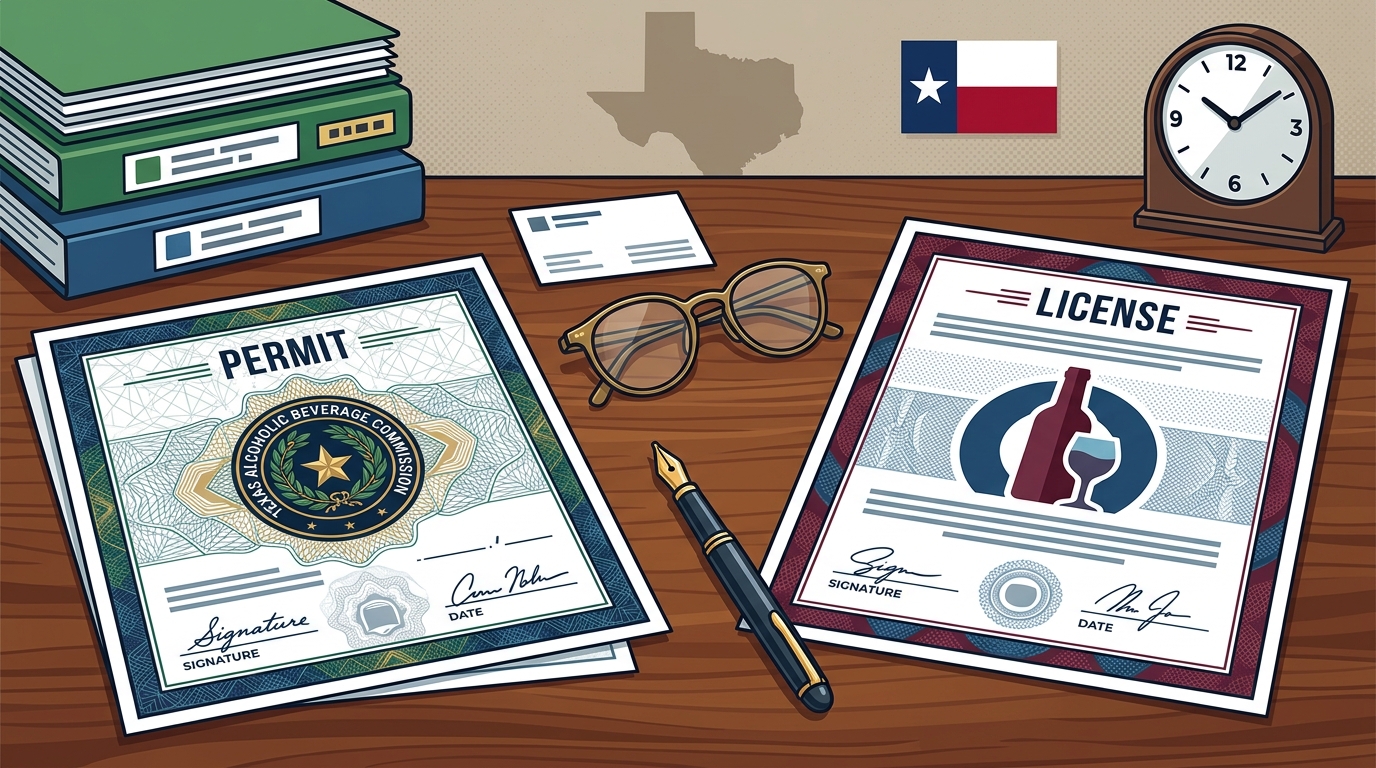
Many Texas business owners confuse TABC permits with liquor licenses, leading to costly filing errors. A TABC permit is a state-issued authorization to sell or serve alcohol, while a liquor license is a broader term often used interchangeably in Texas. Gerald Franklin Agency helps you identify the exact permit class required for your specific business model and location. This guide covers the regulatory differences, local requirements, and the step-by-step process to secure your approval.
Regulatory Definitions: Permits vs. Licenses
In Texas, the terminology can be confusing because the state uses specific codes for different types of alcohol sales. Understanding these definitions is the first step to compliance.
What is a TABC Permit?
A TABC permit is a specific authorization issued by the Texas Alcoholic Beverage Commission that allows a business to sell or serve a particular category of alcohol. Each permit class, such as the Mixed Beverage Permit or the Package Store Permit, has distinct rules regarding hours, location, and product types.
What is a Liquor License?
A liquor license is a general term often used by the public to describe any state authorization to handle alcohol. In Texas, there is no single document called a "liquor license." Instead, businesses hold specific permits that collectively serve the function of a license. For example, a restaurant holds a Mixed Beverage Permit, which functions as its liquor license.
Why the Distinction Matters
The distinction matters because each permit class carries different fees, tax rates, and operational restrictions. Filing for the wrong class can result in denied applications or the need to reapply, which delays your opening date. Gerald Franklin Agency specializes in matching your business concept to the correct TABC permit code to ensure you are not over-permitted or under-permitted.
Local Regulatory Requirements
Securing a state permit is only half the battle. Texas law requires local certifications from your county and city before the TABC will issue your permit. These local steps are where many applicants get stuck.
County and City Certifications
Every TABC application requires signatures from the county clerk and the city secretary or mayor. In major metros like Houston, Austin, and Dallas, this means coordinating with multiple local offices. For instance, in Houston, you must obtain certification from the Harris County Clerk and the City of Houston. In Austin, you must work with the Travis County Clerk and the City of Austin.
Distance and Zoning Rules
Local ordinances often impose stricter distance requirements than state law. You must verify that your location is a sufficient distance from schools, churches, and other alcohol retailers. Additionally, some cities have specific zoning rules that prohibit certain types of alcohol sales in residential areas. Gerald Franklin Agency reviews your specific address against local codes to ensure your site is eligible before you sign a lease.
Local Fees and Bonds
Local governments charge their own fees for processing alcohol applications. These fees are separate from the state TABC fees and can vary significantly by city. Some jurisdictions also require local surety bonds in addition to the state-mandated conduct bond. Understanding these local costs upfront helps you budget accurately for your launch.
Choosing the Right Permit Class
Once you understand the local requirements, you must select the correct permit class. The right choice depends on what you sell, where you sell it, and how customers consume it.
On-Premise Permits
On-premise permits allow customers to consume alcohol at your location. The most common on-premise permit is the Mixed Beverage Permit (MB), which allows the sale of spirits, wine, and beer for on-site consumption. This is the standard permit for bars, full-service restaurants, and hotels. Another option is the Wine and Malt Beverage Permit (BG), which allows the sale of wine and beer but not spirits.
Off-Premise Permits
Off-premise permits allow customers to take sealed containers home. The Package Store Permit (P) is the license for traditional liquor stores that sell spirits, wine, and beer. The Wine and Malt Beverage Retailer's Off-Premise Permit (BQ) allows convenience stores and grocery stores to sell wine and beer but not spirits. Each off-premise permit has specific rules regarding store hours and employee age requirements.
Specialized Permits
Some businesses need specialized permits. The Private Club Registration Permit (N) is for member-based clubs that serve alcohol to members and their guests. The Temporary Event Permit allows one-time or short-run events to sell alcohol. Choosing the right class is critical because switching permit types later is difficult and expensive. Gerald Franklin Agency helps you map your business model to the correct permit class during the initial consultation.
| Permit Class | Code | Best For | Key Restriction |
|---|---|---|---|
| Mixed Beverage | MB | Bars, Restaurants, Hotels | On-premise consumption only |
| Package Store | P | Liquor Stores | Off-premise, sealed containers |
| Wine and Malt Retailer | BG | Wine Shops, Cafes | No spirits sales |
| Private Club | N | Member Clubs | Must be a non-profit corporation |
Surety Bonds and Financial Guarantees
Most TABC permits require a surety bond as a financial guarantee that your business will comply with state alcohol laws. The bond protects the state, not the business owner.
The Conduct Surety Bond
Food and Beverage Certificate Exemption
Businesses that derive more than 60% of their revenue from food sales may qualify for a Food and Beverage Certificate (FB). This certificate can exempt you from the conduct surety bond, saving you thousands of dollars. It also allows for "alcohol to go" sales in some cases. Gerald Franklin Agency helps you determine if your menu and revenue mix qualify for this exemption.
Other Bond Types
Wholesale and import operations require a Liquor and Beer Tax Bond, which guarantees the payment of excise taxes. The amount of this bond is based on your estimated tax liability and scales with your volume. Understanding which bonds apply to your specific permit class is essential for accurate budgeting.
The Application and Approval Process
Once you have the right permit class and local certifications, you can file your application with the TABC. The process involves several steps that must be completed in the correct order.
Step 1: Document Preparation
You must gather all required documents, including your business formation documents, lease agreement, and floor plan. You also need to complete the TABC application forms, which are available through the AIMS portal. Accuracy is critical at this stage, as errors can lead to delays.
Step 2: Local Filing
Before the TABC will review your application, you must file with your local county clerk and city. This involves obtaining the required signatures and paying local fees. In many cases, the local offices will not process your application until they have received the state application number.
Step 3: TABC Review and Inspection
After local filing, the TABC reviews your application. They may schedule an interview and inspect your premises to ensure it meets safety and zoning requirements. The inspection checks for things like fire exits, occupancy limits, and proper signage.
Step 4: Final Approval and Issuance
Once the TABC approves your application, you must pay the state fees and any remaining local fees. The TABC then issues your permit, and you can begin selling alcohol. The entire process can take several months, so it is important to start early. Gerald Franklin Agency manages this entire workflow, ensuring that no step is missed and that your application moves through the system as quickly as possible.
Key Takeaways
- A TABC permit is a specific state authorization, while a liquor license is a general term for any alcohol sales permit.
- Local certifications from your county and city are required before the TABC will issue your permit.
- The Mixed Beverage Permit (MB) is for on-premise consumption, while the Package Store Permit (P) is for off-premise sales.
- Most permits require a conduct surety bond, which can be exempted with a Food and Beverage Certificate.
- Distance rules from schools and churches are strictly enforced and must be verified before signing a lease.
- The application process involves local filing, TABC review, inspection, and final approval.
- Working with an expert like Gerald Franklin Agency can help you navigate the complex local and state requirements.
Frequently Asked Questions
Do I need a liquor license to sell beer in Texas?
Yes, you need a TABC permit to sell beer. The specific permit depends on whether you are selling on-premise (like a restaurant) or off-premise (like a convenience store). A restaurant would need a Mixed Beverage or Wine and Malt permit, while a convenience store would need a Wine and Malt Beverage Retailer's Off-Premise Permit.
What is the difference between a TABC permit and a local license?
A TABC permit is issued by the state and authorizes you to sell alcohol. A local license or certification is issued by your city or county and is required to obtain the state permit. You need both to legally operate.
How long does it take to get a TABC permit?
The timeline varies by permit class and location, but it typically takes several months. The process involves local filing, state review, inspection, and final approval. Starting early is crucial to avoid delays in your opening date.
Can I sell alcohol to go with a Mixed Beverage Permit?
Generally, no. A Mixed Beverage Permit allows for on-premise consumption only. To sell alcohol to go, you typically need a Food and Beverage Certificate attached to your permit, which allows for limited to-go sales of wine and beer.
What is a conduct surety bond?
Do I need a separate permit for each location?
Yes, each physical location requires its own TABC permit. If you open a second location, you must file a new application for that specific address. The permits are not transferable between locations.
Can I apply for a TABC permit myself?
Yes, you can apply yourself, but the process is complex and involves coordinating with multiple local and state agencies. Many business owners choose to work with a licensing agency like Gerald Franklin Agency to ensure their application is complete and accurate.