
Can I Get a Surety Bond for My Liquor License?
Yes, you can and likely must get a surety bond for your Texas liquor license. The Texas Alcoholic Beverage Commission (TABC) requires specific financial guarantees to protect the state and the public. Gerald Franklin Agency helps you identify the exact bond required for your specific permit class and location. This guide covers bond amounts, license types, and the filing process.
Understanding Bond Amounts
A surety bond is a three-party contract between your business, a surety company, and the state. It guarantees that your business will follow state alcohol laws. The amount of the bond depends on your specific permit and your location relative to sensitive sites like schools.
Standard Conduct Bond Amounts
Wholesale and Import Bonds
Food and Beverage Certificate Exemption
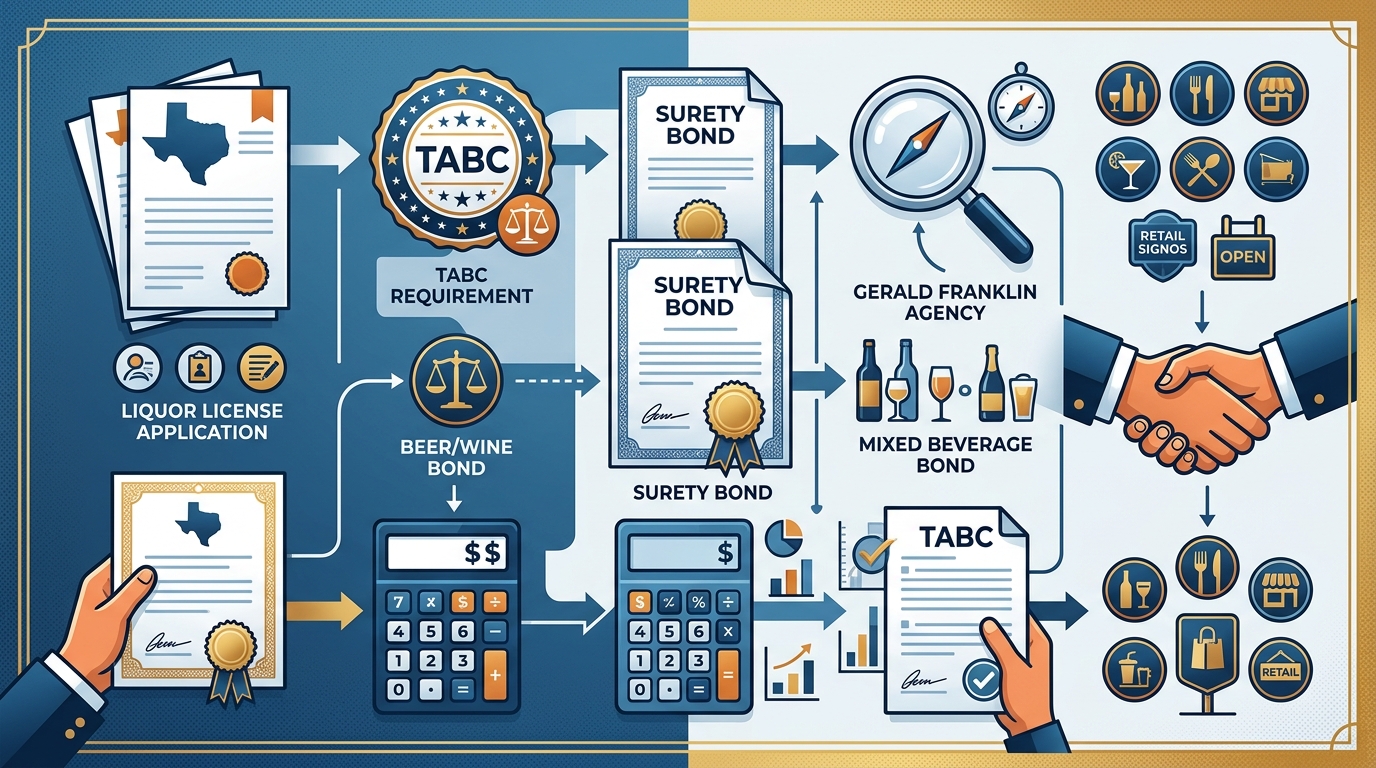
Liquor License Types and Bond Requirements
Not all liquor licenses require the same bond. The specific permit you hold determines which financial guarantees are mandatory. Understanding the difference between on-premise and off-premise permits is critical for budgeting and compliance.
On-Premise Permits
The Mixed Beverage Permit (MB) is the full-service permit for bars, restaurants, and hotels. It allows the sale of spirits, wine, and beer for on-site consumption. This permit typically requires a conduct surety bond unless you hold a Food and Beverage Certificate. The Wine and Malt Beverage Permit (BG) allows for beer and wine service and also generally requires a conduct bond if you do not meet the food sales threshold.
Off-Premise Permits
Comparison of Common Permits and Bonds
| Permit Type | Code | Primary Use | Required Bond | Standard Bond Amount |
|---|---|---|---|---|
| Wholesaler | W | Distribution | Liquor and Beer Tax Bond | ~6 weeks of tax liability |
Choosing the right permit is the first step in securing the correct bond. Gerald Franklin Agency helps you match your business concept to the correct permit class to ensure you are not over-permitted or under-permitted.
Key Takeaways
- Wholesalers and importers require a Liquor and Beer Tax Bond based on estimated tax liability.
- A Food and Beverage Certificate can exempt restaurants from the conduct bond requirement.
- Bonds must be maintained for the first three years of operation for new businesses.
- You must provide 30 days written notice to cancel a bond and replace it if needed.
- Good standing with the TABC and current state taxes are required to maintain a bond.
- Gerald Franklin Agency issues bonds in-house and files them directly with the TABC.
Frequently Asked Questions
Who needs a conduct surety bond?
Locations that derive more than 60 percent of revenue from alcohol need a conduct bond. This includes Mixed Beverage, Private Club, Wine and Malt, on-premise retail, and package store permits. If you hold a Food and Beverage Certificate, you may be exempt.
How much does the conduct bond cost?
Can I cancel my surety bond?
Yes, but you must provide 30 days written notice to the TABC. You must also file a replacement bond or a Food and Beverage Certificate before the current bond is released. You cannot simply stop paying for the bond without following this process.
Do I need a bond for a Wine and Malt Off-Premise Permit?
How long must I keep the bond?
New alcohol businesses must maintain the conduct bond for the first three years of operation. After three years, if you have a clean record, you may qualify for release from the bond requirement. Wholesalers must keep their tax bonds for as long as the permit is active.
What happens if I violate the law?
If your business violates state alcohol laws, the state can file a claim against your surety bond. The surety company pays the claim and then seeks reimbursement from your business. This is why maintaining compliance and good documentation is essential.
Does Gerald Franklin Agency handle the bond filing?
Yes, Gerald Franklin Agency issues the conduct bond in-house and files it into the TABC AIMS portal. This ensures the bond never holds up your permit issuance. We also handle the local certifications required by your county and city.