
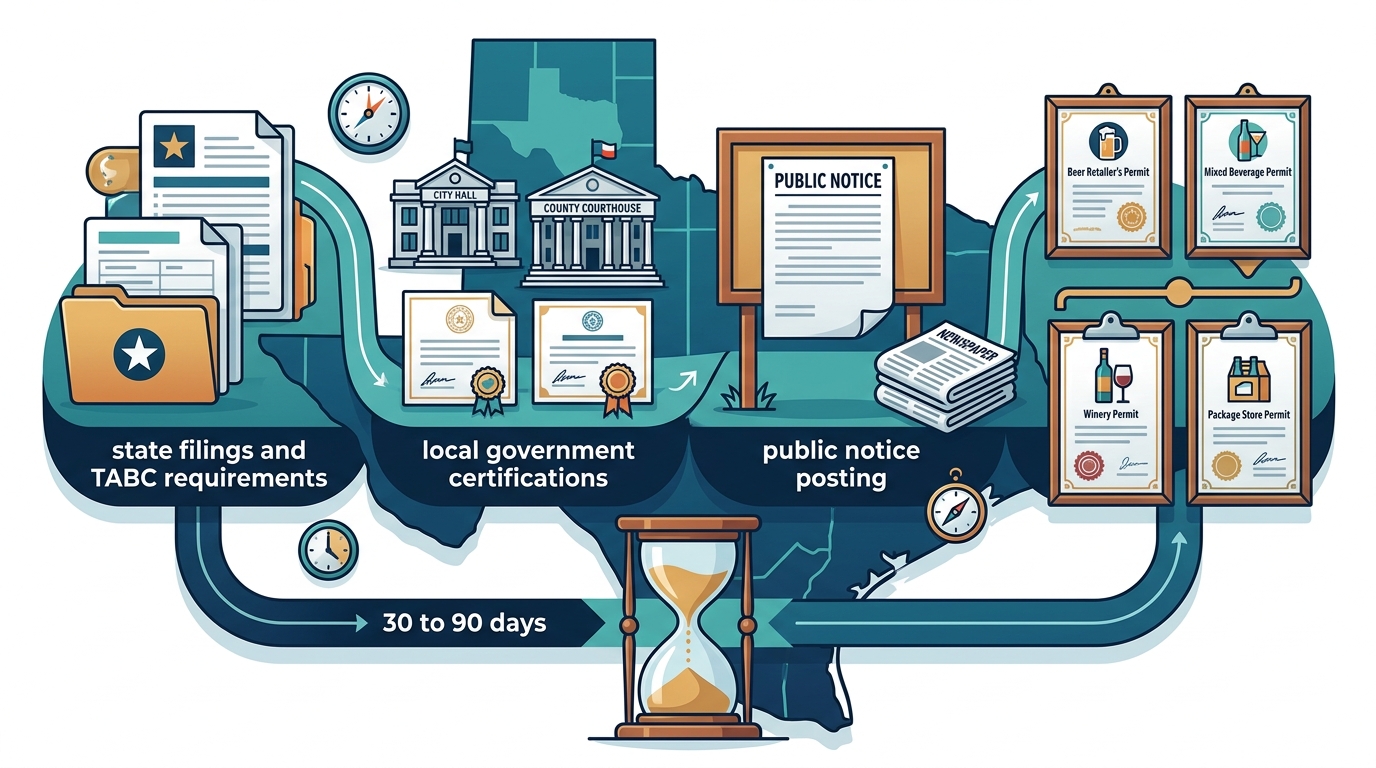
Getting a TABC permit requires filing a state application, securing local government certifications, and posting public notices. The process typically takes 30 to 90 days depending on the permit type and local jurisdiction. This guide covers the four main permit types, public notice rules, and the exact processing timeline you should expect in 2026.
TABC Permit Types
Choosing the right permit is the first critical step in the licensing process. A TABC permit is a state-issued authorization that allows a business to sell or serve specific types of alcohol. The Texas Alcoholic Beverage Commission (TABC) categorizes these permits into distinct classes based on the product sold and the location of consumption.
On-Premise Permits
On-premise permits allow customers to consume alcohol within the business premises. The most common on-premise permit is the Mixed Beverage Permit (MB), which authorizes the sale of spirits, wine, and beer for on-site consumption. This is the standard permit for full-service bars and restaurants. Another key on-premise option is the Wine and Malt Beverage Retailer's Permit (BG), which allows the sale of wine and beer on the premises but does not cover distilled spirits.
Off-Premise Permits
Off-premise permits allow customers to purchase sealed containers to take home. The Package Store Permit (P) is the license for traditional liquor stores, authorizing the sale of spirits, wine, and beer in sealed containers. The Wine and Malt Beverage Off-Premise Permit (BQ) allows convenience stores and grocery stores to sell sealed wine and beer, but not spirits. Selecting the correct code is essential, as the fees, bond requirements, and local restrictions differ significantly between these classes.
Public Notice Requirements
Public notice is a mandatory legal step that ensures community transparency before a new alcohol license is issued. A public notice is a formal announcement published in a local newspaper that informs residents of the pending application. This requirement allows community members to review the application and file objections if they believe the new business will negatively impact the neighborhood.
Newspaper Publication
Applicants must publish the notice in a newspaper of general circulation in the county where the business is located. The notice must include specific details, such as the name of the applicant, the location of the business, the type of permit sought, and the date of the public hearing. The TABC requires that the notice be published at least 30 days before the scheduled hearing date. Failure to publish the notice correctly can result in the rejection of the application or a delay in the approval process.
Local Certifications
In addition to newspaper publication, the application requires certifications from local officials. These include signatures from the County Clerk, the City Secretary (if in an incorporated area), and the County Judge. These local certifications confirm that the applicant meets specific zoning and distance requirements, such as maintaining a minimum distance from schools, churches, and parks. Gerald Franklin Agency handles these local certifications in person, ensuring that all signatures are obtained correctly and on time.
Processing Timeline
The overall processing timeline for a TABC permit varies based on the complexity of the application and the local jurisdiction. A TABC permit processing timeline is the total duration from the initial filing to the final issuance of the license. For most standard applications, this process takes between 30 and 90 days. However, complex cases or those with public objections can take longer.
Initial Review
Once the application is filed through the TABC AIMS portal, the state conducts an initial review to ensure all required documents are present. This stage typically takes 10 to 15 business days. If any documents are missing or incorrect, the TABC will issue a deficiency notice, which pauses the clock until the applicant provides the necessary corrections. Accurate initial filing is crucial to avoiding these delays.
Local Hearing
After the state review, the application moves to the local level for a public hearing. The County Judge schedules this hearing, which usually occurs 30 to 60 days after the public notice is published. During this hearing, the judge reviews the application and any objections filed by community members. If the judge approves the application, it is sent back to the TABC for final processing.
Application Processing Timeline
Understanding the specific stages of the application processing timeline helps businesses plan their opening dates accurately. The timeline is divided into distinct phases, each with its own duration and requirements. Below is a reference table summarizing the typical durations for each phase of the TABC permit process.
| Phase | Typical Duration | Key Actions |
|---|---|---|
| Document Preparation | 1-2 Weeks | Gathering financial statements, background checks, and lease agreements. |
| State Filing | 1-2 Weeks | Submitting the application via the TABC AIMS portal. |
| Public Notice | 30 Days | Publication in a local newspaper and waiting period. |
| Local Hearing | 30-60 Days | County Judge review and public objection period. |
| Final Approval | 1-2 Weeks | TABC final review and issuance of the permit. |
Final Approval and Issuance
After the County Judge approves the application, the file is returned to the TABC for final processing. This stage involves verifying that all local certifications are complete and that the required surety bonds are in place. The TABC then issues the final permit, which the business must display prominently on the premises. The entire process, from start to finish, requires careful coordination between the state, local government, and the applicant.
Key Takeaways
- Selecting the correct TABC permit type (MB, BG, P, or BQ) is the foundation of a successful application.
- Public notice must be published in a local newspaper at least 30 days before the hearing.
- Local certifications from the County Clerk, City Secretary, and County Judge are mandatory.
- The total processing timeline typically ranges from 30 to 90 days for standard applications.
- Accurate initial filing prevents deficiency notices that can delay the process by weeks.
- Working with experienced professionals ensures that all local and state requirements are met efficiently.
Frequently Asked Questions
How long does it take to get a TABC permit?
The process typically takes 30 to 90 days, depending on the permit type and local jurisdiction. Complex cases with public objections may take longer.
What is the difference between a Mixed Beverage and a Wine and Malt permit?
A Mixed Beverage Permit allows the sale of spirits, wine, and beer on the premises. A Wine and Malt Permit allows the sale of wine and beer but does not cover distilled spirits.
Do I need a public notice for every permit?
Yes, most TABC permits require a public notice published in a local newspaper to inform the community of the pending application.
Who signs the local certifications?
The County Clerk, City Secretary, and County Judge must sign the local certifications to confirm that the business meets zoning and distance requirements.
What happens if my application is rejected?
If the County Judge rejects the application, you can appeal the decision. It is advisable to consult with a licensing expert to understand the reasons for rejection and how to address them.
Can I operate my business while waiting for the permit?
No, you cannot sell or serve alcohol until the TABC permit is officially issued and displayed on the premises.