
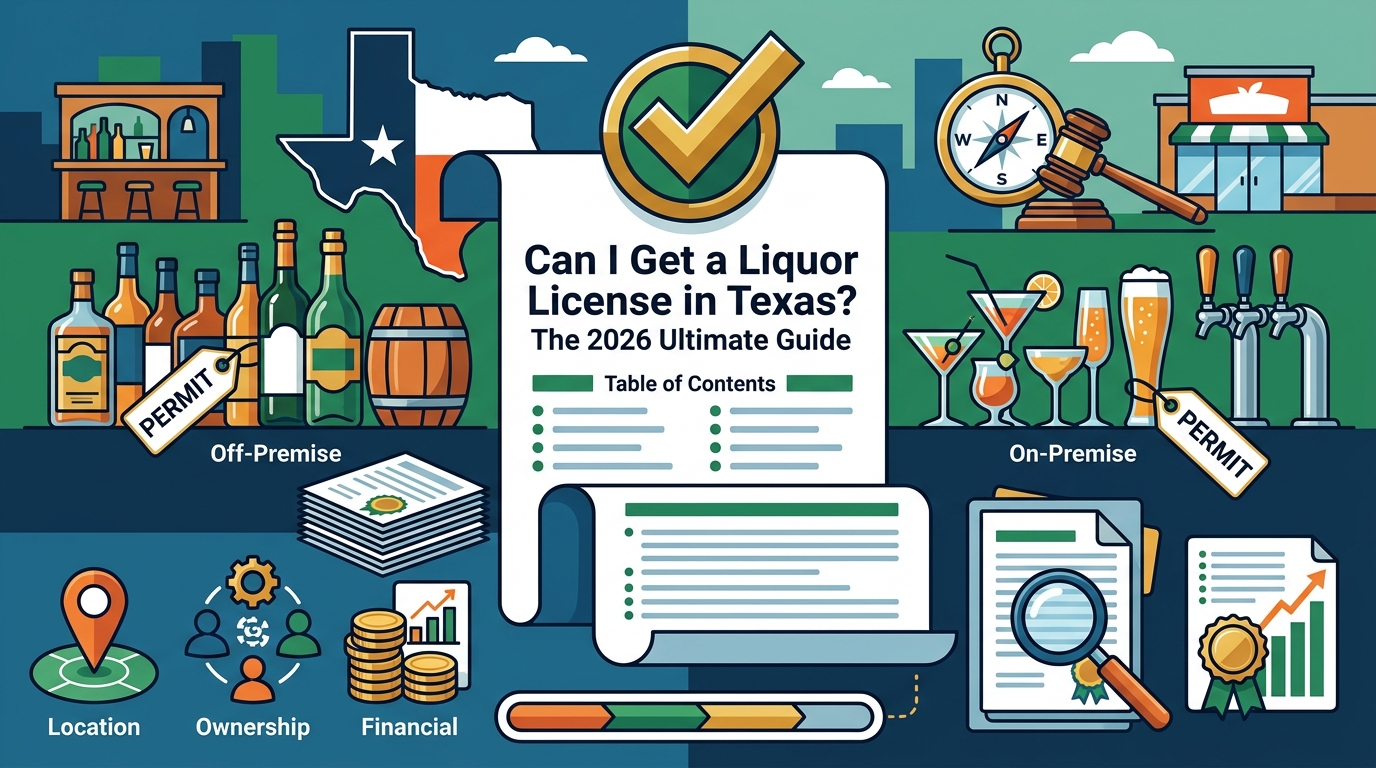
Yes, you can get a liquor license in Texas, provided your business meets strict location, ownership, and financial requirements. The Texas Alcoholic Beverage Commission (TABC) regulates all alcohol sales, requiring specific permits for on-premise and off-premise consumption. This guide covers the permit types, application process, eligibility rules, and local approvals you need to open your doors on time.
Liquor Permit Types
Understanding the specific permit class is the first step in securing legal alcohol sales. A Texas liquor permit is a state-issued authorization that allows a business to sell, serve, or store alcoholic beverages. The TABC categorizes these permits based on the type of alcohol and the location of consumption. Choosing the wrong class can result in denied applications or significant fines.
On-Premise Permits
On-premise permits allow customers to consume alcohol within the business premises. The most common is the Mixed Beverage Permit, which authorizes the sale of spirits, wine, and beer for on-site consumption. This permit is essential for bars, nightclubs, and full-service restaurants. It carries higher state fees and requires a conduct surety bond unless the business holds a Food and Beverage Certificate.
Off-Premise Permits
Off-premise permits allow customers to purchase sealed containers for consumption elsewhere. The Package Store Permit is the standard license for traditional liquor stores selling distilled spirits. The Wine and Malt Beverage Retailer's Permit allows the sale of beer and wine in sealed containers. These permits have different operating hours and zoning restrictions compared to on-premise licenses.
Certificates and Subordinate Permits
Certificates attach to primary permits to expand capabilities. The Food and Beverage Certificate verifies that a business is food-first, often exempting it from the conduct bond. The Late Hours Certificate extends service times to 2:00 AM. These subordinate documents are critical for maximizing revenue and operational flexibility.
TABC Application Process
The application process is rigorous and requires precise documentation. A TABC application is a formal request submitted through the TABC's online portal, AIMS. The process involves multiple layers of review, including state, county, and city approvals. Missing a single signature or failing a background check can delay your opening by months.
Step 1: Document Preparation
You must gather all required documents before filing. This includes the TABC application form, state and federal criminal history reports for all owners with a 20 percent or greater interest, and financial statements. Accuracy is paramount; any discrepancy can trigger a denial.
Step 2: Local Filing
Before the TABC reviews your file, you must obtain local certifications. This involves filing with the county clerk, the city secretary, and the Texas Comptroller of Public Accounts. These offices verify your business registration and local compliance. In many Texas cities, this step requires in-person visits to specific government offices.
Step 3: State Review and Inspection
Once local certifications are complete, the TABC reviews the application. They will schedule an interview with the applicants and inspect the physical premises. The inspection checks for compliance with safety codes, proper storage, and signage. After approval, the county judge must sign off on the final application.
Eligibility Requirements
Not every business or individual qualifies for a Texas liquor license. Eligibility is determined by ownership background, location distance, and financial standing. A liquor license eligibility check is a critical pre-filing step to avoid wasted fees and time.
Ownership and Background Checks
All individuals with a 20 percent or greater ownership interest must undergo state and federal criminal history checks. Certain criminal convictions, particularly those involving moral turpitude or alcohol-related offenses, can disqualify an applicant. The TABC reviews these reports thoroughly, and any red flags require immediate attention.
Distance and Zoning Rules
Your business location must meet specific distance requirements from sensitive sites. For example, a package store must be a certain distance from schools, churches, and other liquor stores. These distances are measured property line to property line. Failing to meet these zoning rules is a common reason for application denial.
Financial and Tax Standing
Applicants must be in good standing with the Texas Comptroller of Public Accounts. You must have a current sales and use permit and be up to date on all state tax filings. Additionally, most permits require a surety bond, which guarantees compliance with state alcohol laws. The bond amount varies based on the permit type and location.
Local Approvals
State approval is only half the battle. Local approvals are mandatory and often the most complex part of the process. A local liquor approval is a certification from county and city officials that your business complies with local ordinances. These approvals vary significantly by jurisdiction.
County Clerk Certification
The county clerk verifies that your business is registered and that the location is zoned correctly for alcohol sales. They also confirm that you have paid any required local fees. This certification is a prerequisite for the TABC to move your file forward.
City Secretary and Mayor Approval
In incorporated areas, the city secretary or mayor must approve the application. This involves a review of local zoning, noise ordinances, and public safety concerns. Some cities have specific hours of operation or restrictions on the type of alcohol that can be sold. Understanding these local nuances is essential for a successful application.
County Judge Final Sign-Off
The county judge holds the final authority to approve or deny the liquor license. They review the entire file, including the TABC's recommendation and any public objections. If the judge denies the application, you may have the right to appeal, but this process is lengthy and uncertain.
Liquor License Types
While often used interchangeably, licenses and permits have distinct legal definitions in Texas. A Texas liquor license is a broad term that encompasses all state authorizations for alcohol sales. The TABC uses specific codes to identify each type, which determines your operational rights and fees.
Mixed Beverage Permit (MB)
The MB permit is the most versatile on-premise license. It allows the sale of mixed drinks, spirits, wine, and beer. It is the standard choice for bars and restaurants. The state fee for this permit is higher than other classes, reflecting the broader scope of sales.
Package Store Permit (P)
The P permit is exclusive to traditional liquor stores. It allows the sale of distilled spirits in sealed containers. This permit has strict operating hours, typically closing at 9:00 PM on weekdays and 8:00 PM on Saturdays. It is closed on Sundays and major holidays.
Wine and Malt Beverage Permit (BG)
The BG permit allows the sale of wine and beer. It can be used for on-premise consumption in restaurants or off-premise sales in retail stores. This permit is often chosen by businesses that do not want to handle spirits but want to offer a full beverage menu.
Texas Licensing Process
The overall licensing process is a coordinated effort between state and local agencies. A Texas licensing process is a multi-stage workflow that can take several months to complete. Timing is critical, as you cannot legally sell alcohol until the final permit is issued.
Pre-Filing Assessment
Before you sign a lease, you should conduct a site analysis. This involves checking distance rules, zoning codes, and local saturation. A professional assessment can save you from signing a lease for a location that is ineligible for a liquor license.
Parallel Filing Strategy
Experienced operators file for health permits, operating permits, and liquor licenses in parallel. This approach ensures that all approvals arrive close together, preventing a single missing item from holding up your opening. Coordinating these filings requires a deep understanding of local government workflows.
Final Issuance and Compliance
Once the county judge approves the application, the TABC issues the final permit. You must then post the required signage and complete any final inspections. After issuance, you must maintain compliance with all state and local regulations, including regular renewals and tax filings.
Local Approval Requirements
Local approval requirements are the specific documents and signatures needed from county and city officials. A local approval requirement is a jurisdiction-specific mandate that varies by city and county. These requirements are often the source of delays for first-time applicants.
Required Signatures
Most local approvals require signatures from the county clerk, city secretary, and county judge. These signatures confirm that the business meets local standards. In some jurisdictions, the mayor or city council must also vote on the application. Understanding who needs to sign and in what order is crucial.
Public Notice and Objections
In many areas, you must publish a public notice of your intent to apply for a liquor license. This notice allows neighbors and competitors to file objections. If objections are filed, the county judge may hold a public hearing. Being prepared for this process is essential for a smooth approval.
Local Fees and Bonds
In addition to state fees, local jurisdictions may charge their own application fees and require local bonds. These fees vary widely by city. Some cities charge a percentage of the state fee, while others have flat rates. Budgeting for these local costs is a critical part of your financial planning.
Key Takeaways
- Yes, you can get a liquor license in Texas, but it requires strict adherence to state and local rules.
- The TABC uses specific permit codes, such as MB for mixed beverages and P for package stores.
- Local approvals from the county clerk, city secretary, and county judge are mandatory.
- Ownership background checks and distance rules are the most common reasons for denial.
- The application process involves parallel filings with state, county, and city agencies.
- Professional guidance can help navigate the complex local approval requirements.
- Timing is critical; the process can take several months, so start early.
- Maintaining compliance after issuance is essential to keep your license active.
Frequently Asked Questions
How long does it take to get a liquor license in Texas?
The timeline varies by location and permit type, but it typically takes several months. The process involves multiple layers of review, including state, county, and city approvals. Delays often occur during the local certification phase or if the county judge schedules a hearing.
Do I need a bond to get a liquor license?
Can I sell alcohol to go with a Mixed Beverage Permit?
No, a Mixed Beverage Permit only allows on-premise consumption. To sell alcohol to go, you need a Food and Beverage Certificate attached to your permit. This certificate verifies that your business is food-first and allows for takeout sales.
What are the distance requirements for a package store?
Package stores must be a specific distance from schools, churches, and other liquor stores. These distances are measured property line to property line and vary by local ordinance. You must verify these distances before signing a lease to ensure eligibility.
Who can own a business with a liquor license?
All individuals with a 20 percent or greater ownership interest must pass state and federal background checks. Certain criminal convictions can disqualify an owner. The TABC reviews these reports thoroughly, and any red flags can lead to a denial.
Do I need a local health permit?
Yes, if you are serving food, you need a local health department permit. This permit is separate from your liquor license and must be obtained before you open. Coordinating these filings in parallel can help ensure your opening is on schedule.
Conclusion
Securing a liquor license in Texas is a complex but achievable process. It requires a deep understanding of permit types, eligibility rules, and local approval requirements. By planning carefully and working with experienced professionals, you can navigate the TABC application process and open your business on time. Contact Gerald Franklin Agency to start your application today.