
How to Know If You Need a TABC Permit or a Liquor License
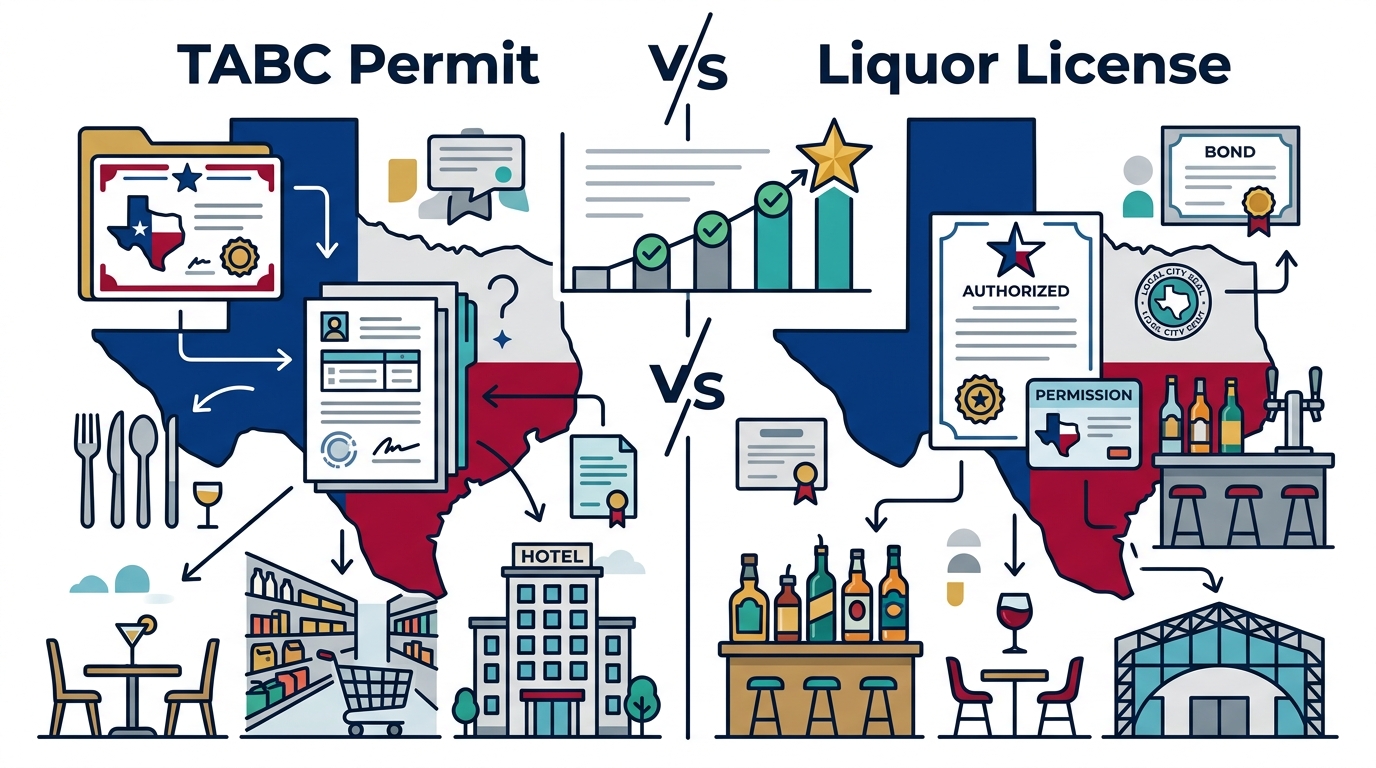
Many Texas business owners confuse the terms "liquor license" and "TABC permit." In practice, the Texas Alcoholic Beverage Commission (TABC) issues specific permits that authorize the sale or service of alcohol. The exact permit you need depends on your business model, location, and how customers consume the product. This guide explains the differences, local rules, and the steps to secure the right authorization for your Texas business.
Local Regulatory Requirements
Securing alcohol authorization in Texas is a two-tier process involving both state and local authorities. While the TABC handles the state-level permit, local jurisdictions impose their own rules. A local regulatory requirement is a set of rules enforced by city or county officials that must be satisfied before the state will issue a permit. These local rules often dictate whether a specific location is eligible for alcohol sales at all.
County and City Certifications
Before the TABC will approve an application, the applicant must obtain certifications from local officials. In most Texas counties, this involves signatures from the county clerk and the county judge. In incorporated cities, the city secretary or mayor may also need to sign off. Gerald Franklin Agency manages these local certifications, ensuring that the paperwork is routed to the correct offices and that local fees are paid on time.
Distance and Zoning Rules
Local ordinances frequently impose distance requirements between alcohol establishments and sensitive locations like schools, churches, and parks. A distance rule is a local regulation that prohibits alcohol sales within a specific radius of these protected sites. If your business is too close to a school, for example, the local certification may be denied, which effectively blocks the state permit. Understanding these zoning and distance rules is critical before signing a lease.
Local Wet and Dry Regulations
One of the most significant factors in Texas alcohol licensing is the "wet" or "dry" status of the local jurisdiction. A dry jurisdiction is a city or county that has voted to prohibit the sale of alcohol within its boundaries. Conversely, a wet jurisdiction allows alcohol sales. Because Texas is a state with strong local control, the rules vary dramatically from one county to the next, and even from one city to another within the same county.
Understanding Dry Areas
In a dry county, you generally cannot obtain a standard retail or on-premise permit for a new business. However, there are exceptions. For instance, a private club registration may be possible in some dry areas if the club is not open to the general public. Additionally, some dry counties allow for "wet" enclaves where specific cities have voted to permit alcohol sales. Gerald Franklin Agency helps clients navigate these complex local boundaries to determine if their specific address is in a wet or dry zone.
Impact on Permit Availability
The wet or dry status directly impacts which permits are available. In a dry area, a Package Store Permit is typically impossible to obtain. In a wet area, all standard permits are available, subject to local distance and quota rules. It is essential to verify the status of your specific location with the county clerk and city secretary before investing in a business plan that relies on alcohol revenue.
Choosing the Right Permit Type
Once you have confirmed that your location is in a wet jurisdiction and meets local distance rules, you must select the correct TABC permit. The permit type is determined by what you sell and where the customer consumes it. Choosing the wrong permit can result in fines, permit revocation, or the inability to operate as intended.
On-Premise vs. Off-Premise
The primary distinction in Texas licensing is between on-premise and off-premise consumption. An on-premise permit allows customers to drink at your location, while an off-premise permit allows them to take sealed containers home. The table below summarizes the most common permit types.
| Permit Type | Code | Consumption | Typical Business |
|---|---|---|---|
| Mixed Beverage Permit | MB | On-Premise | Bars, Restaurants, Clubs |
| Wine and Malt Beverage Retailer | BG | On-Premise | Wine Bars, Breweries |
| Package Store Permit | P | Off-Premise | Liquor Stores |
| Wine and Malt Off-Premise | BQ | Off-Premise | Convenience Stores, Grocery |
Special Certificates and Bonds
Some businesses require additional certificates or bonds. For example, a Food and Beverage Certificate (FB) is required for restaurants that want to sell alcohol to go or operate in certain restricted areas. Additionally, most on-premise permits require a conduct surety bond, which guarantees that the business will comply with state laws. Gerald Franklin Agency issues these bonds in-house, ensuring they are filed correctly with the TABC.
The Application Process
Applying for a TABC permit is a multi-step process that requires coordination between the applicant, local officials, and the state. The process begins with a site analysis to ensure the location is eligible. It then moves to the preparation of the application, local filings, and finally, the state review.
Step-by-Step Workflow
First, you must gather the necessary documents, including ownership information and financial statements. Next, you file the application with the TABC through the AIMS portal. Simultaneously, you must submit the application to the local county and city offices for certification. Once the local officials sign, the TABC reviews the application, which may include an interview and a premises inspection. Finally, after approval, you must pay the state and local fees to receive the permit.
Why Professional Help Matters
Many applicants make errors in the local filing stage, which delays the entire process. Because the TABC will not review an application until the local certifications are complete, a single missing signature can hold up your business for months. Gerald Franklin Agency, with its team of former TABC professionals, ensures that every step is handled correctly and on time, allowing you to open your doors without unnecessary delays.
Key Takeaways
- "Liquor license" is a general term; the TABC issues specific permits based on your business model.
- Local wet or dry status is the first and most critical factor in determining permit eligibility.
- Local regulatory requirements, such as distance rules and zoning, must be met before state approval.
- On-premise permits (like Mixed Beverage) allow drinking at the venue, while off-premise permits (like Package Store) allow sealed sales.
- Most on-premise permits require a conduct surety bond to guarantee compliance with state laws.
- The application process involves both state (TABC) and local (county/city) filings, which must be coordinated.
- Professional assistance can prevent costly delays caused by errors in local certifications or distance calculations.
Frequently Asked Questions
What is the difference between a TABC permit and a liquor license?
In Texas, the terms are often used interchangeably by the public, but the TABC issues specific permits. A "liquor license" is a colloquial term for any TABC permit that authorizes the sale or service of alcohol. The specific type of permit depends on whether you sell on-premise or off-premise and what types of alcohol you handle.
Can I get a liquor license in a dry county?
Generally, no. In a dry county, the sale of alcohol is prohibited, so standard retail and on-premise permits cannot be issued. However, there are limited exceptions, such as private club registrations, which may be possible in some dry areas if specific conditions are met.
How long does it take to get a TABC permit?
The timeline varies by permit type and local jurisdiction. On average, the process can take several months. Delays often occur during the local certification stage or if the TABC schedules an interview or inspection. Working with an expediting agency can help streamline this process.
Do I need a bond for my permit?
Most on-premise permits, such as the Mixed Beverage Permit, require a conduct surety bond. This bond protects the state by guaranteeing that your business will follow alcohol laws. The amount of the bond depends on the type of permit and the location of your business relative to schools.
What happens if I choose the wrong permit?
If you operate under the wrong permit, you may face fines, penalties, or the revocation of your license. It is crucial to select the permit that matches your business model and consumption rules. If your business model changes, you may need to apply for a different permit or a modification.
How does Gerald Franklin Agency help with this process?
Gerald Franklin Agency provides end-to-end assistance with TABC permits. We analyze your location for wet/dry status and distance rules, prepare the application, manage local certifications, and issue the required bonds. Our team of former TABC professionals ensures that your application is complete and accurate, reducing the risk of delays.