
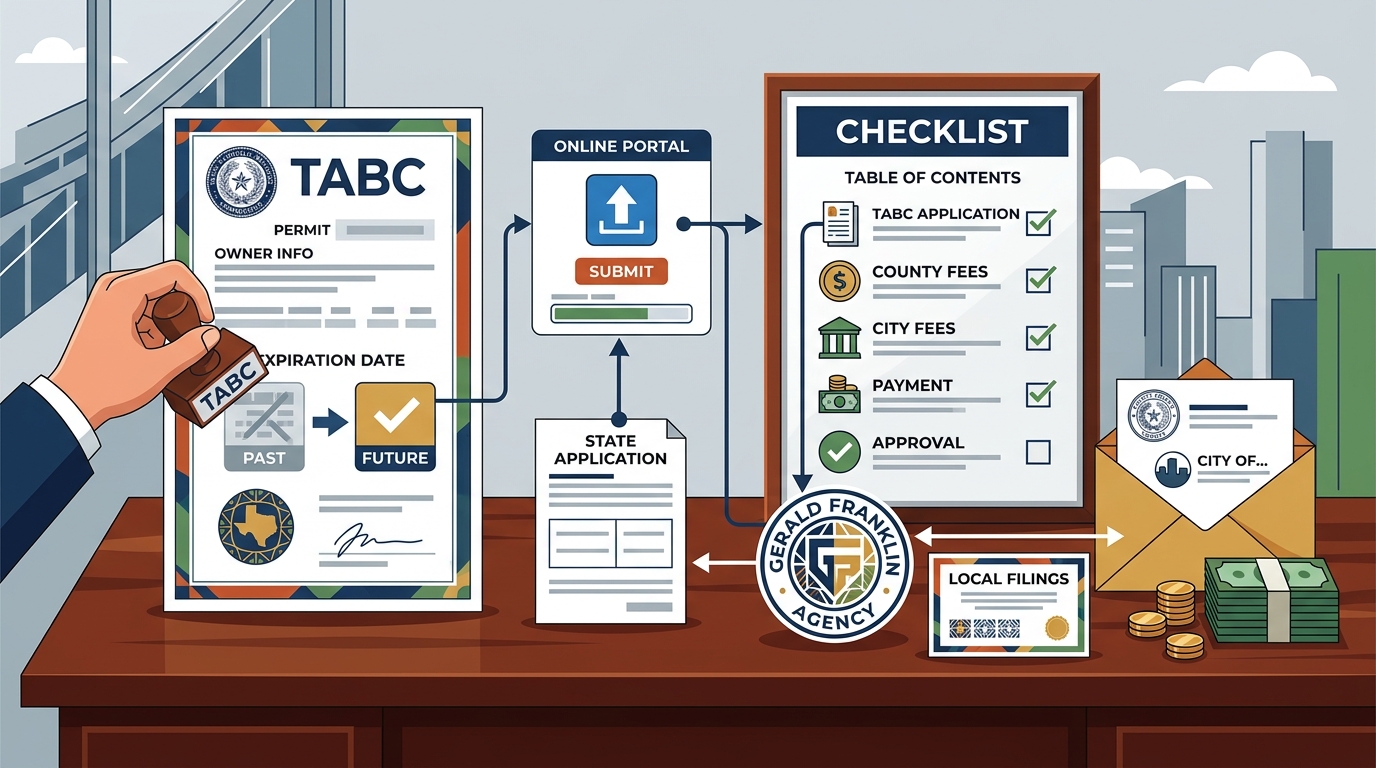
Renewing your TABC permit is a two-part process involving state and local filings. You must submit your renewal application to the Texas Alcoholic Beverage Commission (TABC) before your current permit expires, and you must simultaneously pay the required local fees to your county and city. Gerald Franklin Agency handles both the state and local components to ensure your business remains compliant and open for business without interruption.
Renewal Timing Windows
Understanding the exact timeline for your renewal is the most critical step in the process. A TABC permit renewal is the administrative procedure used to extend the validity of an existing alcohol license for a new term. Missing the deadline can result in a lapse in coverage, which may force you to close your doors or apply for a new permit from scratch.
State Filing Deadlines
The TABC requires that renewal applications be filed before the expiration date printed on your current permit. While the state allows for a grace period in some cases, relying on this is risky. The TABC processes renewals through their AIMS portal, and the system will flag your account as expired if the application is not submitted on time. We recommend submitting your state renewal at least 30 days before your expiration date to allow for any potential administrative delays.
Local Filing Deadlines
Local jurisdictions in Texas often have their own specific deadlines that may differ from the state. In many counties, the local renewal must be filed by a specific date, often the last day of the month preceding your permit expiration. Because local fees and state fees are separate, you must ensure both are paid by their respective deadlines. Gerald Franklin Agency tracks these dual deadlines for you, ensuring that neither the state nor the local office flags your file as delinquent.
Local Fee Requirements
Many business owners assume that paying the TABC state fee completes the renewal process. This is a common misconception. A local renewal fee is a separate payment made to your county clerk or city secretary to maintain your local certification. These fees are not included in the state fee and must be paid directly to the local authority.
County and City Certifications
When you first obtained your permit, you received a local certification from your county and city. This certification is tied to your specific business location and must be renewed alongside your state permit. The amount of the local fee varies by jurisdiction. In some cities, the local fee is a flat rate, while in others, it is calculated as a percentage of the state fee. For example, in Houston, local fees are often a specific percentage of the state fee, but this can change based on city ordinances.
Payment Methods and Processing
Local fees are typically paid via check or money order, though some jurisdictions now accept electronic payments. The processing time for local renewals can vary. While the TABC may process your state renewal in a few weeks, your local office may take longer to issue the updated certification. It is essential to keep copies of all payment receipts for both the state and local filings. Gerald Franklin Agency manages these local payments and certifications, ensuring that your file is complete and that you receive your updated local certification on time.
Key Takeaways
- Renewing your TABC permit requires both a state filing and a local fee payment.
- State and local deadlines may differ, so you must track both carefully.
- Local fees are separate from state fees and vary by jurisdiction.
- Missing a deadline can result in a lapse in your permit coverage.
- Gerald Franklin Agency handles both state and local components of the renewal.
- Keep copies of all payment receipts for your records.
- Submit your renewal at least 30 days before your expiration date.
Frequently Asked Questions
How far in advance should I renew my TABC permit?
We recommend submitting your renewal at least 30 days before your expiration date. This allows time for processing and ensures that your new permit is issued before your current one expires.
Do I need to pay local fees if I am renewing my TABC permit?
Yes, you must pay local fees to your county and city. These fees are separate from the state fee and are required to maintain your local certification.
What happens if I miss my renewal deadline?
If you miss your renewal deadline, your permit may lapse. You may be required to apply for a new permit, which can take longer and cost more than a standard renewal.
Can Gerald Franklin Agency handle my local fee payment?
Yes, we handle both the state filing and the local fee payment. We ensure that all deadlines are met and that your file is complete.
How long does the renewal process take?
The processing time varies by jurisdiction. The TABC may process your state renewal in a few weeks, while your local office may take longer. We track the entire process for you.
Do I need to update my business information when renewing?
If your business information has changed, such as your address or ownership, you must update your file with the TABC and your local authorities. We can help you with these updates.
Is there a grace period for TABC permit renewals?
The TABC may allow a grace period in some cases, but relying on this is risky. We recommend submitting your renewal on time to avoid any issues.
How can I check the status of my renewal?
You can check the status of your state renewal through the TABC AIMS portal. For local renewals, you may need to contact your county or city office. We can also provide you with status updates.
Conclusion
Renewing your TABC permit is a straightforward process if you understand the dual requirements of state and local filings. By tracking your deadlines and ensuring that all fees are paid, you can keep your business compliant and open for business. Gerald Franklin Agency has been helping Texas businesses navigate the TABC renewal process since 1944. Our team of former TABC professionals handles the entire process for you, from the state filing to the local fee payment. To start your renewal, today.