
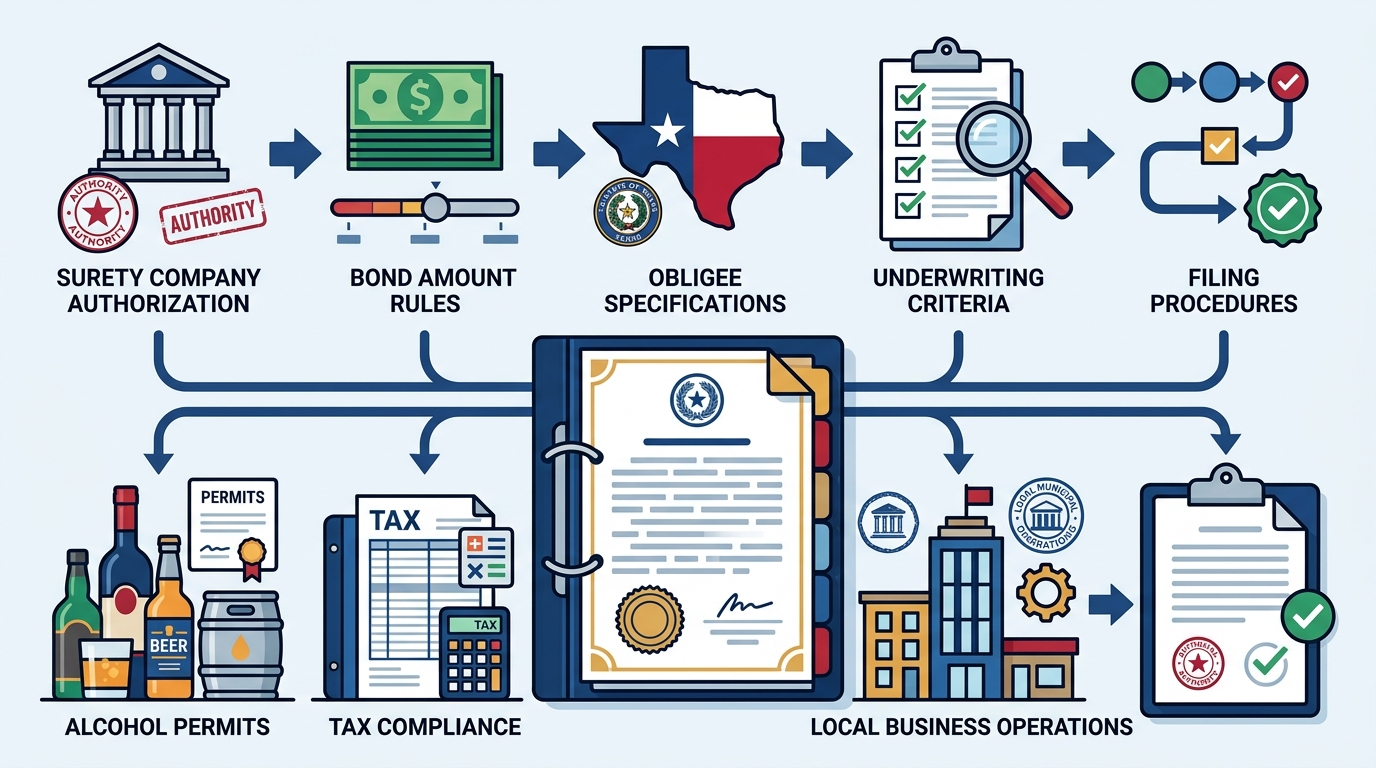
A Texas surety bond is a legally binding three-party contract that guarantees a business will fulfill its legal or financial obligations to the state. This guide covers the five core requirements for securing a bond in Texas: surety company authorization, bond amount rules, obligee specifications, underwriting criteria, and filing procedures. We break down exactly how these rules apply to alcohol permits, tax compliance, and local business operations.
Surety Company Authorization
Not every insurance company can issue a surety bond in Texas. A surety bond is a distinct financial instrument that requires a specific license from the Texas Department of Insurance (TDI). The surety company must be authorized to write surety business in the state and must maintain a strong financial rating to protect the state from default.
Why Authorization Matters
When you purchase a bond, you are not buying insurance in the traditional sense. You are entering a contract where the surety company guarantees your performance. If you fail to meet your obligations, the state (the obligee) can file a claim against the bond. Because of this risk, the state requires the surety company to be financially stable and legally authorized to operate in Texas.
At Gerald Franklin Agency, we issue bonds in-house through our authorized surety partners. This ensures that the bond you receive is valid, recognized by the TABC, and ready for immediate filing. We do not use unlicensed or out-of-state carriers that might cause delays in your permit approval.
Bond Amount Requirements
The amount of your surety bond is not arbitrary. It is determined by the specific permit or license you are applying for and your business’s financial profile. In Texas, bond amounts are often tied to the potential liability of the business or the volume of taxes collected.
Alcohol Permit Bonds
Tax and Wholesale Bonds
Obligee Specifications
The obligee is the party that benefits from the bond. In Texas, the obligee is almost always a government agency. Understanding who the obligee is helps you understand what the bond is actually protecting.
State vs. Local Obligees
For TABC permits, the Texas Alcoholic Beverage Commission is the obligee. The bond protects the state, not the business owner. If you violate state alcohol laws, the TABC can file a claim against the bond to recover damages or penalties. For sales and use tax bonds, the Texas Comptroller of Public Accounts is the obligee. The bond guarantees that you will pay the sales tax you collect from customers.
It is critical to note that the bond does not protect you from liability. It protects the state. If a claim is filed against your bond, you are still responsible for repaying the surety company. This is why compliance and proper documentation are so important.
Underwriting Criteria
Before a surety company will issue a bond, they must underwrite your application. This process assesses your financial health and legal history to determine if you are a good risk. Underwriting criteria vary by bond type but generally focus on three areas: financials, credit, and background.
Financial and Credit Review
For larger bonds, the surety company will request financial statements, tax returns, and a credit report. A strong credit score can lower your premium. If your credit is not perfect, you may still qualify, but you might need to provide collateral or a personal guarantee. We help clients prepare these documents to speed up the underwriting process.
Background Checks
For alcohol permits, the TABC requires state and federal criminal history reports for anyone with a 20 percent or greater interest in the business. The surety company also reviews this information. A clean record is essential for approval. If there are past violations or bankruptcies, the underwriter will evaluate the severity and recency of those events.
Filing Procedures
Once your bond is issued, it must be filed with the correct agency to be valid. Filing procedures vary by permit type, but the process is generally straightforward if you have the right documents.
TABC AIMS Portal
For alcohol permits, the bond is filed through the TABC AIMS portal. The bond must be linked to your primary permit application. We handle this filing for our clients, ensuring that the bond is correctly associated with your permit code and location. This step is critical because a bond that is not properly linked will not satisfy the TABC’s requirements.
Comptroller and Local Filings
For sales and use tax bonds, the bond is filed with the Texas Comptroller. For local operating permits, the bond may need to be filed with your city or county clerk. We coordinate these filings alongside your main permit application, so nothing falls through the cracks. Our team tracks the status of each filing and notifies you when the bond is active.
Key Takeaways
- A Texas surety bond is a three-party contract between the principal (you), the surety company, and the obligee (the state).
- The surety company must be authorized by the Texas Department of Insurance to issue bonds in the state.
- Wholesale and import bonds are sized based on six weeks of estimated excise tax liability.
- The obligee is the government agency that benefits from the bond, such as the TABC or the Comptroller.
- Underwriting criteria include financial statements, credit reports, and background checks.
- Bonds must be filed with the correct agency, such as the TABC AIMS portal or the Comptroller.
- The bond protects the state, not the business owner, so compliance is essential.
Frequently Asked Questions
Who needs a conduct surety bond in Texas?
Locations that derive more than 60 percent of revenue from alcohol and do not hold a Food and Beverage Certificate need a conduct surety bond. This includes Mixed Beverage, Private Club, and Package Store permits.
How much does a conduct bond cost?
Can I cancel my surety bond?
Yes, but you must provide 30 days written notice to the obligee. You must also have a replacement bond or a Food and Beverage Certificate on file before the current bond is released.
What if my credit is not perfect?
You can still qualify for a bond, but you may need to provide collateral or a personal guarantee. We work with surety partners who specialize in helping businesses with less-than-perfect credit secure the bonds they need.
How long must I keep my bond?
For alcohol permits, the conduct bond must be maintained for the first three years of operation. After that, a clean record may qualify you for release. For tax bonds, the bond stays in place as long as your permit is active.