
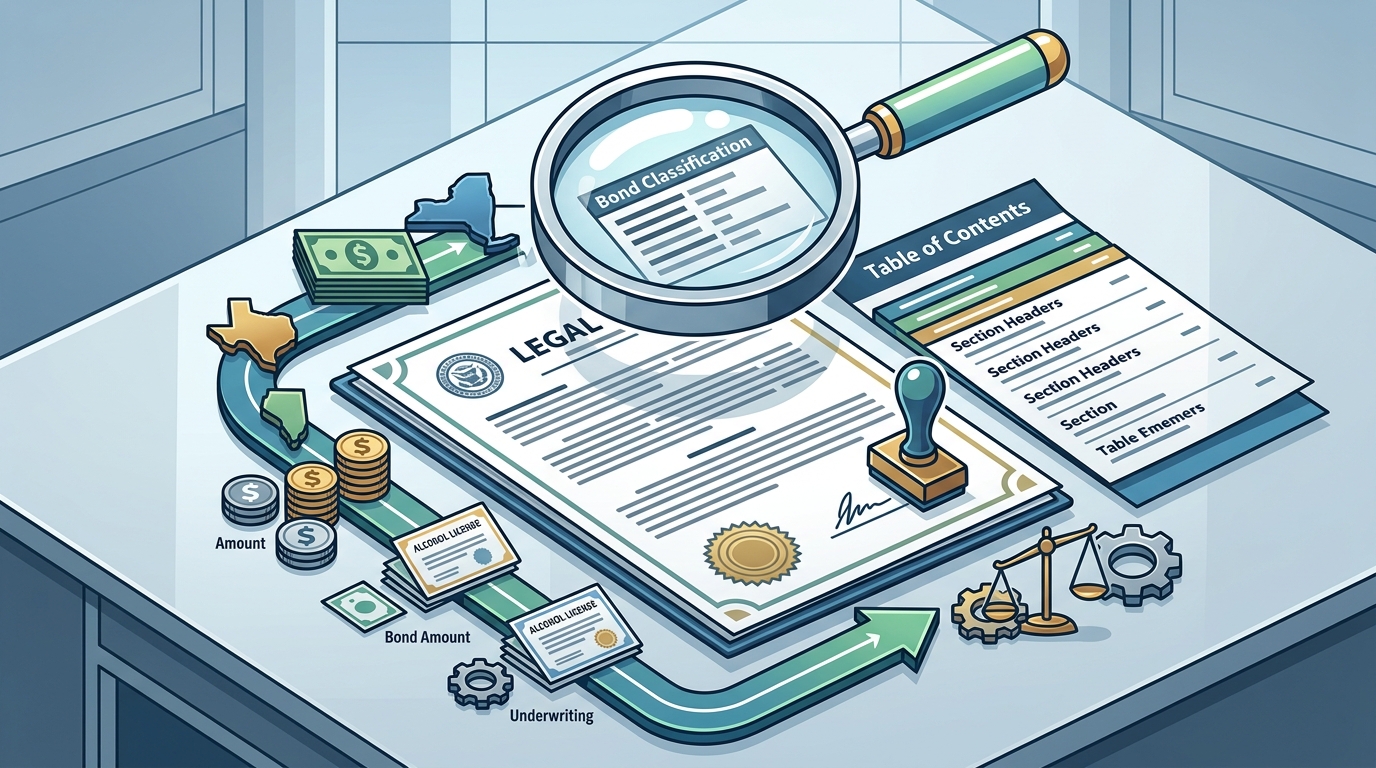
Selecting the correct surety bond requires matching the specific legal obligation to your business model and location. Gerald Franklin Agency helps Texas and New York operators identify the exact bond class, amount, and provider needed to secure their alcohol licenses. This guide covers bond type selection, amount determination, provider comparison, underwriting requirements, and state-specific regulations.
Bond Type Selection
A surety bond is a three-party contract that guarantees a business will fulfill a specific legal or contractual obligation. In the alcohol industry, the bond type is dictated by the permit you hold and the revenue profile of your establishment. Choosing the wrong type can result in application rejection or unnecessary financial exposure.
Conduct Surety Bonds
The conduct bond is the most common requirement for on-premise and retail alcohol permits. It guarantees that the business will operate within the Texas Alcoholic Beverage Code. Most new alcohol businesses that do not hold a Food and Beverage Certificate need this bond to obtain their permit. It protects the state, not the owner, against violations of state alcohol laws.
Permit and Tax Bonds
Wholesale and import operations require different instruments. A liquor and beer tax bond is a financial guarantee required by the TABC Excise Tax Division so the state receives excise taxes owed on alcohol entering the market. This bond protects against non-payment of tax by wholesale and import operations. Additionally, specific permit bonds may be required for certain retail classifications.
Exemptions and Certificates
Not every business needs a conduct bond. A Texas Food and Beverage Certificate is official TABC verification that your primary focus is food service, not alcohol. This certificate can exempt you from the conduct surety bond, potentially saving significant capital. It attaches to a Mixed Beverage or Wine and Beverage permit and verifies that your primary focus is food service.
Bond Amount Determination
The financial amount of a surety bond is not arbitrary; it is calculated based on specific regulatory formulas and risk factors. Understanding how the amount is set helps you budget accurately and avoid over-securing your capital.
Distance and Location Factors
For conduct bonds, the amount is heavily influenced by proximity to sensitive locations. A bond of 5,000 dollars is required when your premises is more than 1,000 feet from a public school. If your location is within 1,000 feet of a school, measured property line to property line, the bond amount doubles to 10,000 dollars. This distance check is a critical step before signing a lease.
Volume Based Calculations
For wholesale and import operations, the bond amount scales with your business volume. The TABC generally sets the amount from an estimate of six weeks of excise tax liability. This figure often starts near 1,000 dollars for new operations and rises as your volume grows. The bond stays in place as long as your permit is active and must be increased when the TABC finds your volume has grown.
Term and Maintenance
Conduct bonds must be maintained for the first three years of operation. After this period, a clean record may qualify you for release. You must provide thirty days written notice to cancel, with a replacement bond or Food and Beverage Certificate on file. Good standing with the TABC and current state taxes are also required to maintain the bond.
Surety Provider Comparison
Choosing a surety provider involves balancing cost, speed, and service quality. Not all providers offer the same level of support for complex alcohol licensing bonds. The table below compares key factors to consider when selecting a provider.
| Factor | In-House Agency Issuance | Third-Party Broker |
|---|---|---|
| Speed of Issuance | Immediate or same-day filing | 1-3 business days for underwriting |
| Integration with Permit | Direct filing into TABC AIMS portal | Manual submission required |
| Renewal Management | Automated tracking and reminders | Manual renewal process |
Gerald Franklin Agency issues the conduct bond in house and files it into the AIMS portal so your permit stays on schedule. This direct integration eliminates the risk of the bond holding up your permit issuance. Premiums often start as low as 100 dollars per year with good credit, making in-house issuance a cost-effective choice for many operators.
Underwriting Requirements
Surety underwriting is the process of evaluating the risk of issuing a bond. For alcohol industry bonds, underwriters look at specific financial and operational metrics. Understanding these requirements helps you prepare your application and avoid delays.
Credit and Financial History
Your personal and business credit scores are primary factors in underwriting. Good credit leads to lower premiums, often starting as low as 100 dollars per year. If your credit is not perfect, you may still qualify, but the premium will be higher. Underwriters also review your financial statements to ensure you have the capacity to cover potential claims.
Regulatory Standing
Good standing with the TABC is a non-negotiable requirement. This includes having current state taxes and no outstanding violations. For wholesale operations, monthly excise tax filings through AIMS, due by the 15th of each month, must be current. Zero reports must be filed even in months with no sales. Failure to maintain this standing can result in bond cancellation.
Business Experience
Underwriters consider the experience of the business owners. A track record of successful operation in the alcohol industry reduces perceived risk. For new businesses, the experience of the principals and the strength of the business plan are critical. Gerald Franklin Agency helps you present your application in the best light, leveraging our decades of experience inside Texas alcohol regulation.
State Specific Regulations
Alcohol licensing is run state by state, and every state has its own regulator, license classes, and bond requirements. Understanding the specific rules in your state is essential for compliance.
Texas TABC Regulations
In Texas, the TABC requires specific bonds for different permit classes. The conduct bond is required for most on-premise and retail permits unless exempted by a Food and Beverage Certificate. The amount is determined by distance to schools and the type of permit. The TABC also requires a liquor and beer tax bond for wholesale and import operations, set from an estimate of six weeks of excise tax liability.
New York SLA Regulations
New York runs alcohol licensing through the New York State Liquor Authority, the SLA, under the state Alcoholic Beverage Control Law. Bond requirements in New York differ from Texas and are specific to the type of license held. Gerald Franklin Agency prepares your application, files it through New York Business Express, serves the mandatory notices, and manages the review through to approval. We handle the full range of licensing and permitting expediting across the state.
Multi-State Considerations
If you operate in multiple states, each state has its own agency and license classes. We already handle Texas and New York and are adding states, so your expansion is covered under one relationship. Managing multi-state licensing as one coordinated program ensures your openings stay on schedule as you scale. A single point of contact for your whole portfolio simplifies compliance and reduces administrative burden.
Key Takeaways
- A surety bond is a three-party contract guaranteeing legal compliance, not insurance for the owner.
- The conduct bond is required for most on-premise and retail alcohol permits in Texas.
- Bond amounts for conduct bonds are 5,000 dollars or 10,000 dollars based on distance to schools.
- Wholesale and import bonds are calculated from six weeks of estimated excise tax liability.
- A Food and Beverage Certificate can exempt you from the conduct surety bond.
- In-house issuance by a licensing agency ensures direct filing into the TABC AIMS portal.
- Good credit and regulatory standing are critical for favorable underwriting and lower premiums.
- Multi-state operators need to manage bond requirements for each state's specific regulator.
Frequently Asked Questions
Who needs a conduct surety bond?
Locations that derive more than 60 percent of revenue from alcohol, which means no Food and Beverage Certificate, need a conduct bond. This includes Mixed Beverage, Private Club, Wine and Malt Beverage, on premise retail, and package store permits.
How much does the conduct bond cost?
The bond amount is 5,000 dollars if your premises is more than 1,000 feet from a public school, or 10,000 dollars within 1,000 feet. Premiums often start as low as 100 dollars per year with good credit.
What if my credit is not perfect?
You can still qualify for a bond with less than perfect credit, but the premium will be higher. Underwriters assess your overall financial profile, including business experience and regulatory standing, not just credit score.
Can I cancel the bond?
Yes, but you must provide thirty days written notice to cancel. You must have a replacement bond or Food and Beverage Certificate on file before the current bond is released.
How is the liquor and beer tax bond amount set?
The TABC sets the amount from an estimate of six weeks of excise tax liability. This figure often starts near 1,000 dollars and rises with your volume. The bond must be increased when the TABC finds your volume has grown.
Do I need a separate bond for each state?
Yes, each state has its own regulator and bond requirements. If you operate in Texas and New York, you need to comply with the specific bond rules of both the TABC and the SLA. Gerald Franklin Agency manages these filings for you.
How long must I keep a conduct bond?
The conduct bond must be maintained for the first three years of operation. After this period, a clean record may qualify you for release. You must maintain good standing with the TABC and current state taxes throughout this period.
Ready to Secure Your Bond?
Gerald Franklin Agency is the largest private liquor licensing agency in Texas, serving clients since 1944. Our team of former TABC professionals prepares, files, and tracks your application from the first question to final approval. We handle TABC permits and surety bonds for businesses across Texas, New York, and nationwide. To plan your visit or start your application, .