
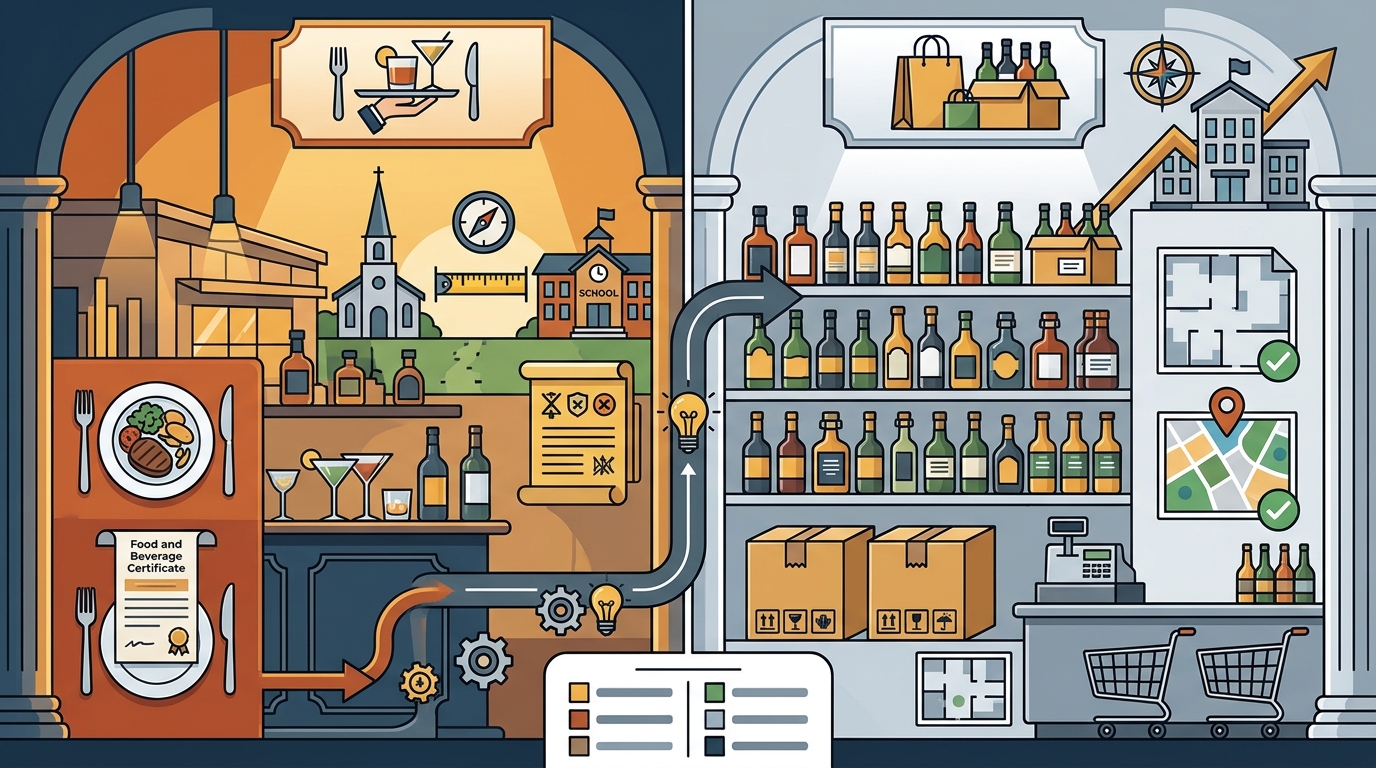
On-premise licenses in Texas require a Food and Beverage Certificate and strict distance rules from schools and churches, while off-premise licenses focus on sealed container sales and specific retail location criteria. On-premise permits suit bars and restaurants serving drinks on-site, whereas off-premise licenses fit liquor stores and retailers selling sealed containers. Gerald Franklin Agency helps Texas businesses navigate these distinct regulatory paths to ensure compliance and timely approval.
On-Premise License Requirements
An on-premise license is a permit that authorizes a business to serve alcoholic beverages for consumption within the establishment's physical boundaries. In Texas, the primary on-premise permit is the Mixed Beverage Permit, which allows the sale of spirits, wine, and beer. To obtain this permit, a business must first secure a Food and Beverage Certificate, which requires that the establishment serves a full menu of food items. This requirement ensures that alcohol is consumed in a dining environment rather than as a standalone retail product.
Distance and Location Rules
Location is the most critical factor for on-premise applicants. Texas law generally prohibits on-premise alcohol sales within 1,000 feet of a school, college, or university, and within 500 feet of a church. These distance rules are measured from the nearest point of the proposed business to the nearest point of the restricted facility. If a business is located within these zones, it may still qualify for an exception if it holds a Food and Beverage Certificate, but the specific distance requirements can vary by local municipality. Gerald Franklin Agency performs site analysis to verify that a location clears these state and local distance rules before an applicant signs a lease.
Local Certifications and Bonds
On-premise applications require local certifications from the county clerk and the city or county judge. These officials must sign off on the application to confirm that the business meets local zoning and operational standards. Additionally, applicants must secure a conduct surety bond, which guarantees that the business will comply with state alcohol laws. The bond amount varies based on the type of permit and the local jurisdiction. Former TABC professionals at Gerald Franklin Agency manage these local filings and bond acquisitions to prevent delays caused by missing signatures or incorrect bond amounts. according to Sign Requirements TABC
Off-Premise License Requirements
An off-premise license is a permit that authorizes a business to sell alcoholic beverages in sealed containers for consumption outside the establishment. The most common off-premise permit in Texas is the Package Store Permit, which allows the sale of distilled spirits, wine, and beer. Unlike on-premise permits, off-premise licenses do not require a Food and Beverage Certificate because the alcohol is not consumed on-site. Instead, the focus shifts to retail operations, inventory management, and specific retail location restrictions.
Distance and Zoning Restrictions
Off-premise licenses face different distance rules than on-premise permits. Package stores are generally restricted from being located within 1,000 feet of a school or college, but the rules for churches and other facilities may differ. Some municipalities impose stricter local zoning laws that can further limit where a package store can operate. Because off-premise sales involve sealed containers, the regulatory concern is less about the consumption environment and more about the proximity to sensitive locations like schools. Gerald Franklin Agency reviews local zoning ordinances to ensure that an off-premise location complies with both state and municipal restrictions.
Ownership and Operational Standards
Off-premise applicants must meet specific ownership and operational standards. The Texas Alcoholic Beverage Commission (TABC) requires that the applicant and all owners meet eligibility criteria, including no prior felony convictions involving moral turpitude. The business must also maintain proper record-keeping and inventory controls to track the sale of sealed containers. While a conduct surety bond is still required, the amount and type may differ from on-premise permits. The application process involves filing with the TABC through the AIMS portal, followed by local certifications and a public notice period. Gerald Franklin Agency handles the entire filing process, from initial document preparation to final approval, ensuring that all operational standards are met.
Comparison of On-Premise and Off-Premise Requirements
| Criteria | On-Premise License | Off-Premise License |
|---|---|---|
| Primary Permit Type | Mixed Beverage Permit | Package Store Permit |
| Food Requirement | Requires Food and Beverage Certificate | No food requirement |
| Consumption Location | On-site consumption | Off-site consumption (sealed containers) |
| Distance from Schools | Generally 1,000 feet | Generally 1,000 feet |
| Distance from Churches | Generally 500 feet | Varies by local ordinance |
| Local Certifications | County Clerk and City/County Judge | County Clerk and City/County Judge |
Choosing the Right License for Your Business
Choose On-Premise If
Choose an on-premise license if your business serves food and drinks on-site, such as a restaurant, bar, or hotel. You must be prepared to meet the Food and Beverage Certificate requirements and ensure your location is sufficiently far from schools and churches. This license allows for a broader beverage menu, including spirits, which can significantly impact revenue for hospitality businesses. according to TABC License and
Choose Off-Premise If
Choose an off-premise license if your business sells sealed containers for off-site consumption, such as a package store or retail outlet. You do not need to serve food, but you must comply with retail distance rules and maintain proper inventory records. This license is the standard for businesses focused on retail sales rather than hospitality service.
Frequently Asked Questions
Can a business hold both on-premise and off-premise licenses?
Yes, a business can hold both types of licenses if it meets the requirements for each. For example, a restaurant might hold an on-premise Mixed Beverage Permit to serve drinks and an off-premise permit to sell sealed bottles to go. However, each license requires a separate application, bond, and local certification. Gerald Franklin Agency can manage multiple filings for businesses that need both types of permits.
What happens if my location is too close to a school?
If your location is within the prohibited distance from a school, you may not be able to obtain the license for that specific site. For on-premise permits, holding a Food and Beverage Certificate may allow for some flexibility in certain cases, but the distance rules are strict. For off-premise permits, the distance rules are generally fixed. It is essential to verify the distance before signing a lease. Gerald Franklin Agency performs site analysis to identify potential distance issues before you commit to a location.
How long does the application process take?
The application process typically takes several months, depending on the completeness of the filing and the local certification process. Delays often occur due to missing local signatures or incomplete documentation. Working with an experienced agency can help streamline the process and ensure that all requirements are met the first time. Gerald Franklin Agency tracks the application through the TABC AIMS portal and manages local filings to keep the process moving.
Do I need a surety bond for both license types?
Yes, both on-premise and off-premise licenses require a conduct surety bond. The bond amount may vary based on the type of permit and the local jurisdiction. The bond guarantees that the business will comply with state alcohol laws. Gerald Franklin Agency secures the required bonds as part of the application process, ensuring that the correct amount and type are filed with the TABC. according to Temporary Event Authorizations
Can I transfer my license to a new location?
Transferring a license to a new location is possible but requires a new application and approval. The new location must meet all the same distance and zoning rules as the original location. If the new location is in a different county or city, new local certifications are required. Gerald Franklin Agency handles license transfers and new location assessments to ensure that the business remains compliant during the move.
Next Steps for Texas Business Owners
Understanding the differences between on-premise and off-premise license requirements is the first step in securing the right permit for your business. The regulatory landscape in Texas is complex, with distinct rules for distance, food service, and local certifications. By choosing the correct license type and ensuring your location meets all state and local requirements, you can avoid costly delays and rejections. Gerald Franklin Agency provides expert guidance on every aspect of the licensing process, from initial consultation to final approval. To start your application, for a personalized assessment of your business and location.