How Much Does a Liquor License Cost in Texas?
State Filing Fees by Permit Type
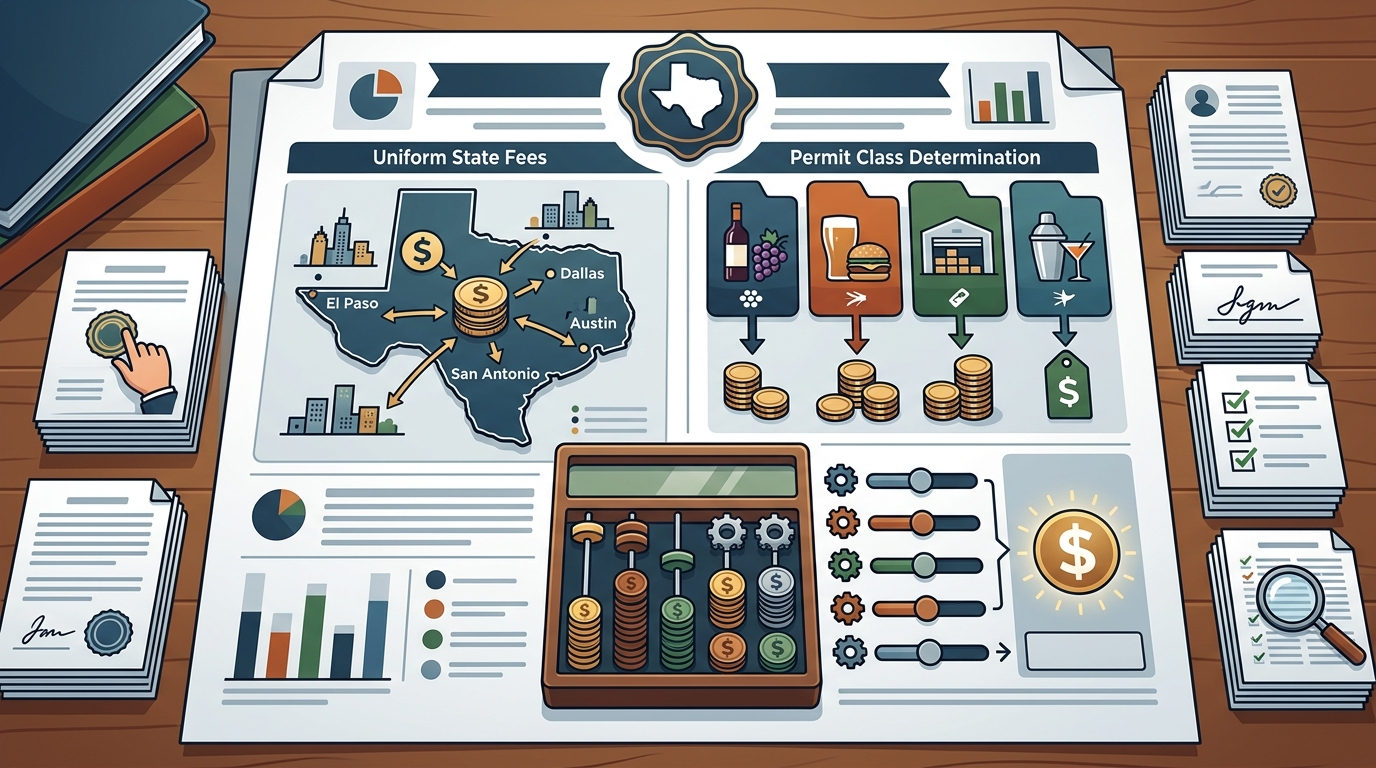
The Texas Alcoholic Beverage Commission (TABC) sets the base cost for every alcohol license in the state. These fees are standardized across Texas, meaning the state portion of your cost is the same whether you are in Houston, Austin, or El Paso. The specific fee depends entirely on the class of permit you need, which is determined by what you sell and how it is consumed.
On-Premise Permits
On-premise permits allow customers to consume alcohol at your location. The most common is the Mixed Beverage Permit, which authorizes the sale of spirits, wine, and beer. For the 2026 term, the state fee for a Mixed Beverage Permit is $5,300. This is the most expensive standard permit because it carries the highest regulatory risk and tax implications. If your business is primarily a restaurant with a full kitchen, you may qualify for a Food and Beverage Certificate, which can reduce your bond requirements but does not lower the base state fee for the underlying permit.
Off-Premise Permits
Off-premise permits allow customers to take sealed containers home. The Package Store Permit, which is the license for traditional liquor stores, carries a state fee of $1,800 for a two-year term. The Wine and Malt Beverage Retailer's Permit, often called the BQ permit, costs $1,900 for two years. This permit allows the sale of beer and wine but not distilled spirits. These lower fees reflect the lower risk profile of sealed container sales compared to on-premise consumption.
Local City and County Fees
While the TABC sets the state fee, local governments in Texas have the authority to impose their own fees and regulations. This is where the total cost of a liquor license in Texas can vary significantly. Local fees are not standardized; they are set by individual city councils and county commissioners. In some jurisdictions, local fees are a small percentage of the state fee. In others, they can be equal to or even exceed the state fee.
City Certifications
Most Texas cities require a local certification or license in addition to the state permit. For example, the City of Houston requires a local fee for its dance hall license if your venue features a dance floor. This local fee is separate from the TABC fee. In other cities, the local fee is a flat amount or a percentage of the state fee. You must file for this local certification with the city secretary or the relevant local authority. The local fee is paid to the city, not the state.
County Certifications
County governments also play a role in the licensing process. The county clerk and the county judge must certify your application. Some counties charge a fee for this certification. In certain areas, the county may also impose a local tax or fee on alcohol sales. It is critical to check with your specific county clerk's office to determine if there is a local fee. In many rural counties, the local fee is minimal or nonexistent, while in urban counties, it can be substantial.
Mandatory Surety Bonds
A surety bond is a financial guarantee that your business will comply with Texas alcohol laws. The TABC requires most on-premise and retail permits to be backed by a conduct surety bond. This bond protects the state, not the business owner. If your business violates the law, the state can file a claim against the bond. The cost of the bond is a premium paid to a surety company, not the full bond amount.
Conduct Surety Bond
Exemptions and Alternatives
Not all businesses need a conduct surety bond. If you hold a Food and Beverage Certificate, which verifies that your business is food-first, you may be exempt from the conduct bond. This exemption can save you the annual premium cost. However, the Food and Beverage Certificate has its own requirements, including a commercial kitchen and a specific ratio of food to alcohol sales. If you do not qualify for the exemption, you must purchase the bond. The bond is a one-time purchase of the policy, but the premium is paid annually.
Additional Costs and Hidden Fees
Beyond the state fee, local fee, and surety bond, there are other costs associated with obtaining and maintaining a liquor license in Texas. These costs are often overlooked in initial budgets but can add up quickly. Understanding these additional costs is essential for accurate financial planning.
Application and Processing Fees
The TABC charges a fee for processing your application. This fee is included in the state fee mentioned above. However, if your application is rejected or requires additional review, you may incur additional costs. For example, if you need to attend a hearing before the county judge, there may be legal fees or administrative costs associated with that process. It is also important to budget for the time and effort required to prepare the application. Many business owners hire a licensing agency to handle the process, which can cost several thousand dollars but can save time and reduce the risk of errors.
Renewal Costs
Liquor licenses in Texas are valid for two years. At the end of the two-year term, you must renew your license. The renewal fee is typically the same as the initial state fee. You must also renew your surety bond and any local certifications. Failure to renew on time can result in penalties or the loss of your license. It is important to set reminders for renewal dates and budget for these recurring costs.
Cost Comparison Table
The following table summarizes the estimated costs for the most common types of liquor licenses in Texas. These figures are for the 2026 term and are subject to change. Local fees and bond premiums are estimates and can vary by jurisdiction and credit score.
| Permit Type | State Fee (2-Year) | Local Fee (Estimate) | Conduct Bond (Annual Premium) | Total Estimated First-Year Cost |
|---|
Note: The local fee estimates are based on typical urban and suburban jurisdictions. Rural areas may have lower or no local fees. The bond premium estimates assume good credit. Poor credit can significantly increase the premium.
Key Takeaways
- The total cost of a liquor license in Texas includes state fees, local fees, and surety bond premiums.
- State fees are standardized: Mixed Beverage is $5,300, Package Store is $1,800, and BQ is $1,900 for two years.
- The conduct surety bond is mandatory for most on-premise permits unless you hold a Food and Beverage Certificate.
- Renewal fees are due every two years and are similar to initial state fees.
- Hidden costs include legal fees, application processing, and potential penalties for late renewal.
- Working with a licensing expert can help navigate local variations and ensure compliance.
Frequently Asked Questions
Is the liquor license fee a one-time cost?
No, the liquor license fee is not a one-time cost. The state fee is paid for a two-year term. You must renew the license every two years and pay the state fee again. Additionally, you must pay annual premiums for your surety bond and any local fees that are billed annually.
Do I need a surety bond for a beer and wine permit?
How long does it take to get a liquor license in Texas?
The timeline varies by permit type and local jurisdiction. On average, it takes 30 to 90 days to obtain a liquor license in Texas. The process involves state review, local certification, and county judge approval. Delays can occur if there are objections or if additional documentation is required.
Can I sell alcohol to go with a Mixed Beverage Permit?
No, a Mixed Beverage Permit only allows on-premise consumption. To sell alcohol to go, you need a separate permit, such as a Wine and Malt Beverage Retailer's Permit or a Package Store Permit. Some businesses hold multiple permits to allow both on-premise and off-premise sales.
What happens if I don't renew my license on time?
If you do not renew your license on time, you may face penalties and the loss of your license. The TABC may impose fines for late renewal. In some cases, you may need to reapply for a new license, which can be a lengthy and expensive process. It is important to renew before the expiration date.
Do local fees apply to all businesses?
Local fees apply to businesses in jurisdictions that have enacted local alcohol regulations. Not all cities and counties charge local fees. You must check with your specific local government to determine if a local fee is required. In some areas, the local fee is a percentage of the state fee, while in others, it is a flat amount.
Conclusion
Understanding the full cost of a liquor license in Texas is essential for any business owner planning to sell or serve alcohol. The total cost is a combination of state fees, local fees, and surety bond premiums. By breaking down each component, you can create an accurate budget and avoid unexpected expenses. The state fees are standardized, but local fees and bond premiums can vary significantly. Working with a professional licensing agency can help you navigate these complexities and ensure that your application is complete and compliant. Gerald Franklin Agency has been helping Texas businesses secure their liquor licenses since 1944. Our team of former TABC professionals can guide you through the process, from initial consultation to final approval. To start your application, today.