
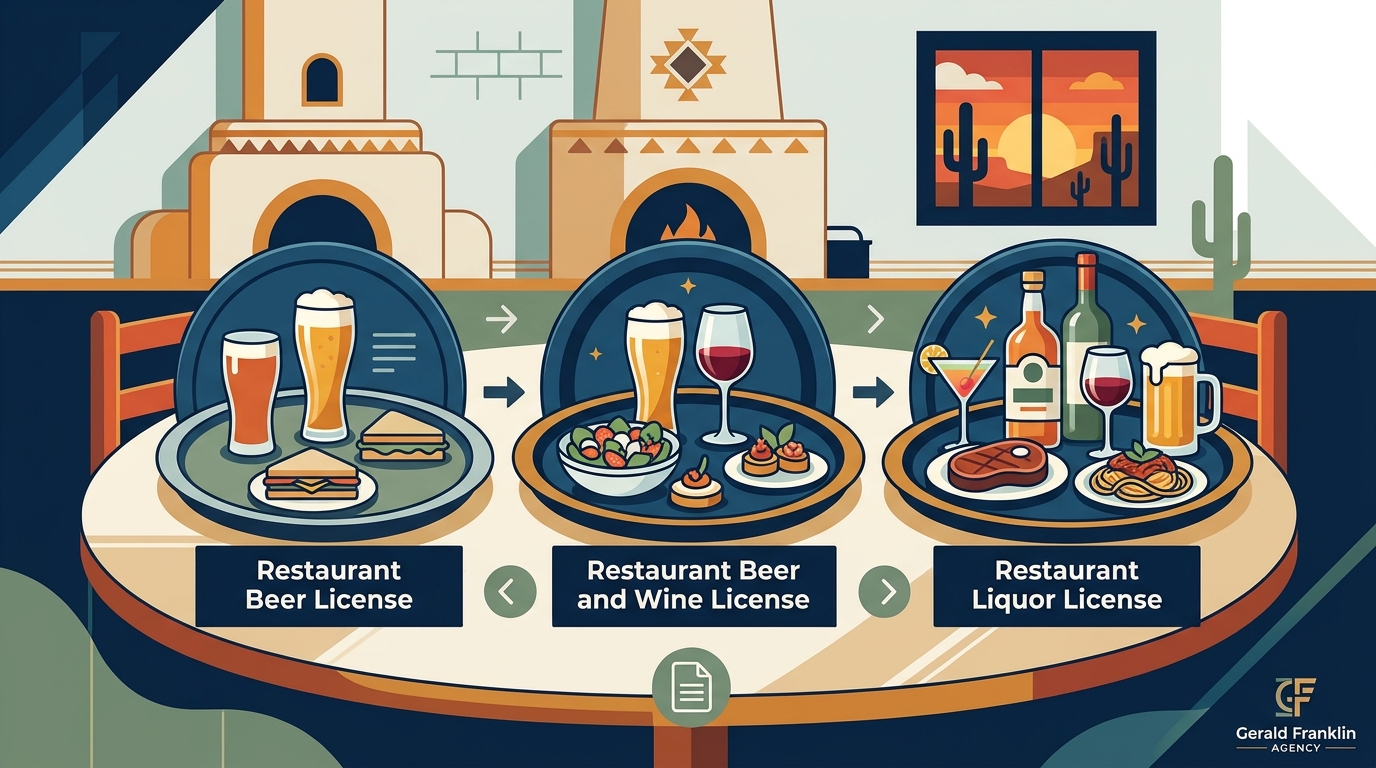
New Mexico offers distinct restaurant liquor license classes that determine whether you can serve spirits, wine, or beer on-premises. The primary options are the Restaurant Liquor License, the Restaurant Beer and Wine License, and the Restaurant Beer License. Each class carries specific operational rules regarding food service ratios, seating requirements, and hours of operation. Gerald Franklin Agency helps restaurant owners navigate these state-specific classifications to ensure the correct permit is filed for their business model.
The Primary Restaurant License Classes
The most common permit for full-service dining establishments is the Restaurant Liquor License. This license authorizes the on-premises sale of distilled spirits, wine, and beer. It is the standard choice for steakhouses, fine dining restaurants, and casual eateries that wish to offer a full bar menu. To qualify, the establishment must meet specific food service requirements, including a minimum number of seats and a food sales ratio relative to alcohol sales.
For businesses that do not plan to serve distilled spirits, the Restaurant Beer and Wine License is the appropriate classification. This permit allows for the sale of beer and wine on the premises but explicitly excludes spirits. It is a popular choice for breweries, wineries, and casual restaurants that want to keep their menu focused on lower-alcohol beverages. The requirements for this license are slightly less stringent than the full liquor license, particularly regarding the food-to-alcohol sales ratio.
The Restaurant Beer License is the most limited of the three primary classes. It authorizes only the on-premises sale of beer. This option is often selected by pizzerias, burger joints, and other casual dining concepts where the primary revenue driver is food rather than alcohol. Understanding these distinctions is critical because applying for the wrong class can result in a denied application or unnecessary compliance burdens.
Food Service and Seating Requirements
New Mexico law ties alcohol licensing to the nature of the food service provided. A restaurant liquor license is not just a permit to sell drinks; it is a certification that the business is a bona fide eating establishment. The state requires that a certain percentage of total gross receipts come from food sales. For a Restaurant Liquor License, the food sales ratio is typically higher than for a beer and wine license.
Seating capacity is another defining factor. The state distinguishes between different types of dining spaces, and the number of seats available to the public can influence which license class is applicable. For example, a venue with a large dining room and a separate bar area may have different compliance needs than a venue where the bar is the primary seating area. Gerald Franklin Agency reviews your floor plan and menu to determine if your physical space meets the state's definition of a restaurant for licensing purposes.
It is important to note that these requirements are not static. Local jurisdictions within New Mexico may have additional ordinances that affect hours of operation or noise levels. While the state sets the baseline for the license type, local rules can add layers of complexity. Ensuring your business plan accounts for both state and local requirements prevents costly delays during the approval process.
Specialized and Ancillary Permits
Beyond the three primary restaurant classes, New Mexico offers specialized permits that may apply to specific restaurant concepts. The Caterer License, for instance, allows for the sale of alcohol at off-premises events, which is essential for restaurants that offer catering services. This is a separate application from your primary restaurant license and requires its own set of compliance documents.
For establishments that operate in dry counties or specific local jurisdictions with restrictions, the rules can vary significantly. Some areas may prohibit certain types of alcohol sales entirely, while others may allow them with additional conditions. A dry county is a jurisdiction where the sale of alcoholic beverages is prohibited by local ordinance. If your restaurant is located in a dry area, you may need to explore alternative licensing paths or consider a different location.
Additionally, restaurants that wish to serve alcohol after standard hours may need to apply for a Late Hours Certificate. This certificate extends the permitted hours of sale, which is crucial for late-night dining concepts. The availability of late hours often depends on the specific city or county where the restaurant is located. Gerald Franklin Agency can verify the local regulations for your specific address to determine if late hours are an option.
Navigating the Application Process
Applying for a restaurant liquor license in New Mexico involves a multi-step process that includes both state and local approvals. The state agency reviews the application for compliance with state law, while the local jurisdiction reviews it for compliance with local ordinances. This dual review process means that a single application can take several months to complete. The timeline depends on the completeness of the application and the responsiveness of the local authorities.
Key components of the application include background checks for all owners and managers, a detailed description of the premises, and proof of insurance. The state requires that all individuals with a significant interest in the business undergo a criminal background check. Any discrepancies or past violations can delay the approval process. It is essential to provide accurate and complete information to avoid these delays.
Working with an experienced licensing agency can streamline this process. Gerald Franklin Agency has expertise in New Mexico liquor licensing and can help you prepare a complete application package. We handle the coordination between the state and local agencies, ensuring that all required documents are submitted on time. This proactive approach helps you open your restaurant on schedule and start serving customers without unnecessary interruptions.
Ongoing Compliance and Renewal
Obtaining a license is only the first step in your alcohol service journey. New Mexico requires license holders to maintain compliance with state regulations on an ongoing basis. This includes keeping records of alcohol sales, ensuring that all staff members are trained in responsible service, and renewing the license before it expires. Failure to renew on time can result in penalties or the suspension of your license.
Responsible service training is a critical component of compliance. The state mandates that servers and managers complete training programs that cover topics such as recognizing intoxication and preventing sales to minors. These training records must be maintained and made available for inspection. Gerald Franklin Agency can help you set up a compliance program that ensures your staff is trained and your records are in order.
Regular inspections by state and local authorities are also part of the compliance landscape. Inspectors may visit your establishment to verify that you are operating within the terms of your license. This includes checking hours of operation, age verification practices, and inventory records. Being prepared for inspections helps maintain a good standing with the regulators and avoids potential fines.
Key Takeaways
- New Mexico offers three primary restaurant license classes: Liquor, Beer and Wine, and Beer.
- The Restaurant Liquor License allows for the sale of spirits, wine, and beer on-premises.
- Food sales ratios and seating requirements are key determinants for license eligibility.
- Local jurisdictions may impose additional rules on hours of operation and noise.
- The application process involves both state and local reviews, which can take several months.
- Ongoing compliance includes staff training, record keeping, and timely license renewal.
- Specialized permits like Caterer and Late Hours Certificates may be needed for specific operations.
Frequently Asked Questions
What is the difference between a Restaurant Liquor License and a Beer and Wine License?
The main difference is the type of alcohol you can serve. A Restaurant Liquor License allows you to serve distilled spirits, wine, and beer. A Restaurant Beer and Wine License allows you to serve only beer and wine, excluding spirits. The food sales ratio requirement is also typically higher for the full liquor license.
Do I need a local approval for my restaurant liquor license?
Yes, New Mexico requires both state and local approval for restaurant liquor licenses. The state agency reviews the application for compliance with state law, while the local jurisdiction reviews it for compliance with local ordinances. Both approvals are necessary before the license is issued.
How long does it take to get a restaurant liquor license in New Mexico?
The timeline can vary depending on the completeness of the application and the responsiveness of the local authorities. It typically takes several months to complete the process. Working with an experienced agency can help streamline the process and reduce delays.
Can I serve alcohol in a dry county?
In most dry counties, the sale of alcoholic beverages is prohibited by local ordinance. However, there may be exceptions or specific conditions under which alcohol can be sold. It is essential to check the local regulations for your specific address to determine if alcohol sales are permitted.
What is a Late Hours Certificate?
A Late Hours Certificate extends the permitted hours of alcohol sales beyond the standard cutoff time. This is useful for restaurants that operate late into the night. The availability of late hours depends on the local jurisdiction and specific regulations.
Do I need to renew my restaurant liquor license?
Yes, restaurant liquor licenses in New Mexico must be renewed periodically. Failure to renew on time can result in penalties or the suspension of your license. It is important to keep track of your renewal date and submit the renewal application before the license expires.
Conclusion
Selecting the right restaurant liquor license in New Mexico is a critical decision that impacts your business operations and compliance obligations. By understanding the differences between the Liquor, Beer and Wine, and Beer licenses, you can choose the option that best fits your business model. Gerald Franklin Agency provides expert guidance on New Mexico liquor licensing, helping you navigate the application process and ensure ongoing compliance. To discuss your specific licensing needs, today.